Kykkos Monastery: history, museum and a visit
About the place
Checked: 2 October 2026.
Why visit Kykkos?
Kykkos is an active Orthodox monastery in the western part of the Troodos Mountains, which visitors flock to for its venerated icon of the Virgin Mary, its ecclesiastical art and its mountainous surroundings. For a first visit, it is a good idea to split the trip into three parts: the monastery courtyard, the church and the museum. This way, the visit is not limited to taking a photograph of the façade, whilst still leaving time for the journey.
Pilgrims and travellers with a variety of interests come together here. In the church, worship remains the main focus, whilst in the museum galleries, the emphasis is on taking a close look at the exhibits. Even if you have come solely for the architecture, please be mindful of the purpose of the premises and follow the staff’s instructions: the tourist route passes through a living religious community.
It’s best to include Kykkos as a separate day trip with a moderate number of stops. The distance shown on the map doesn’t do justice to how long it takes to travel along the winding roads. You shouldn’t plan it as a short addition to a beach holiday with a return strictly by lunchtime: the journey and the sightseeing require plenty of time.
History and monastic tradition
The monastery’s foundation is associated with the reign of the Byzantine Emperor Alexios I Komnenos. Monastic tradition tells of the hermit Isaiah, the healing of the emperor’s daughter, and the transfer of an icon of the Virgin Mary to Cyprus. This is a religious account of the shrine’s origins; it should be read precisely as a legend, rather than as a documented description of a miracle.
Church tradition attributes this venerated icon to the Evangelist Luke. This attribution highlights its significance for the faithful and the tradition of veneration, but does not in itself prove the authorship of the painting. Visitors need not choose between respect for the sacred and a careful approach to historical facts.
The complex has suffered repeated fires and has been rebuilt on several occasions. Consequently, the present-day buildings and their decorative features cannot be regarded entirely as surviving examples of the architecture from the time of its foundation. When examining the site, it is helpful to distinguish between the history of the institution, the age of individual artefacts and the period during which the visible buildings were constructed.
What to see in the courtyard and the church
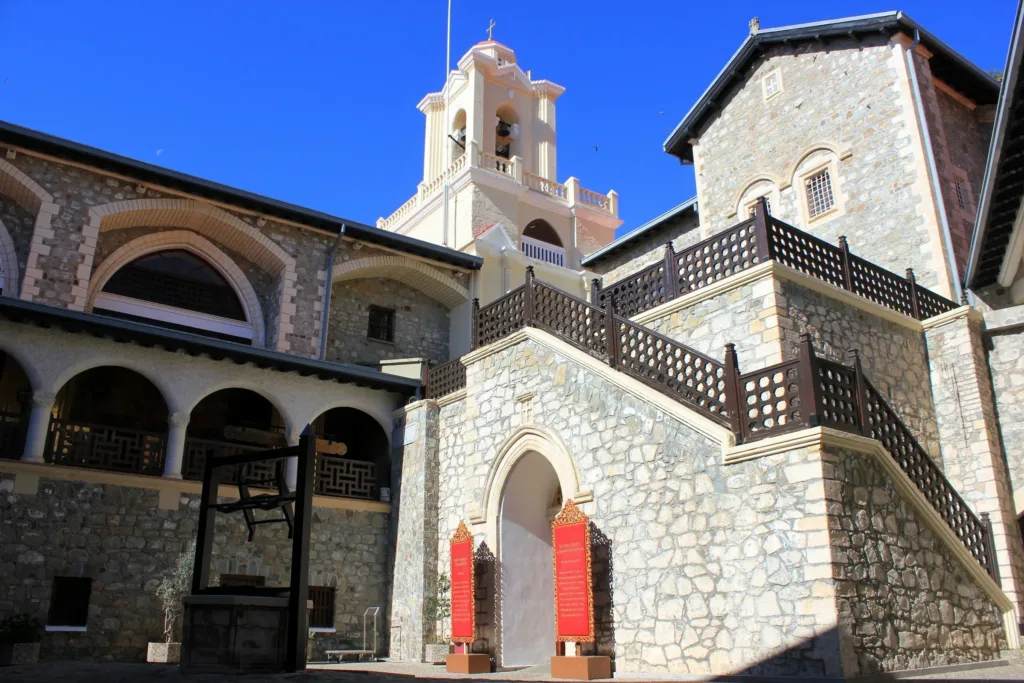
Start with the general layout of the complex: the entrance, galleries, passageways and the inner courtyard. These help you to understand how the monastery connects the areas for visitors with the daily life of the monastery. An open passageway does not mean unrestricted access to every building; please follow the marked route and signs.
Inside the church, the iconostasis and the shrine housing the icon of the Mother of God are particularly noteworthy. Please do not try to look behind the protective coverings or approach restricted areas just to take a photograph. If there is a queue at the shrine, please keep the passageway clear and follow the order maintained by the church staff.
The mosaics and the paintings in the galleries can be viewed as a separate visual narrative. Do not assume that every striking composition dates from the Byzantine era: contemporary décor also contributes to the monastery’s overall appearance. To understand a particular scene, look for a caption or ask the tour guide for clarification.
The museum and neighbouring Troni
The museum on the monastery grounds allows visitors to continue exploring ecclesiastical art outside the worship space. It should be regarded as a separate part of the visit, rather than a compulsory stop on the way to the church. Before you go, please check the current opening hours, admission conditions and the accessibility of the relevant galleries.
When viewing the exhibits, choose a few items to examine and read the accompanying explanations, rather than rushing through all the display cases. It is particularly useful to compare the purpose of the objects with the artistic techniques used. The age of the monastery building and that of a museum exhibit may differ considerably.
Archbishop Makarios III, the first President of the Republic of Cyprus, who served here as a novice, is associated with Kykkos. His grave is located in the Troni area, which should be planned as a separate stop. Please check access routes and open passageways; a visit to the monastery itself does not necessarily mean that the neighbouring area is automatically accessible via the same route.
How to plan a route
Choose a route along ordinary roads and check it against an up-to-date map. The villages of Troodos can serve as waypoints, but the exact sequence depends on your starting point. Do not agree to take a shortcut via a forest track simply because the sat-nav shows fewer kilometres.
In the mountains, the weather and light conditions change more rapidly than on the coast. Check the forecast, any road restrictions and your estimated return journey time. For a winter trip, it is particularly important to assess road conditions in advance; a summer route with good road surfaces is no guarantee that conditions will be the same in another season.
If you’re travelling without a car, check the transport options to the monastery itself and how you’ll get back. The fact that there’s a bus to the nearest village doesn’t guarantee a convenient onward journey. If you’re on an organised tour, it’s worth checking whether the itinerary includes a visit to the museum and some free time, or whether the programme is limited to a brief visit to the church.
Clothing, photographs and access
When visiting an active monastery, please wear modest clothing that covers your shoulders and knees, and comfortable footwear. The requirements may be clarified by the clergy on site. Do not assume that being allowed into the courtyard in ordinary street clothes automatically extends to the church and all interior areas.
When taking photographs indoors, please follow the rules for that particular venue. Do not use a flash when photographing works of art, and do not take photographs of people whilst they are praying without their consent. It is better to take your time exploring the place of worship and take in the overall atmosphere than to hold up the queue whilst searching for the perfect angle.
If you require barrier-free access, a rest area or assistance from a companion, please check the accessibility of the church and museum separately in advance. The mountain complex may include steps and different levels. A general statement regarding the accessibility of the destination does not replace information about a specific entrance or today’s visiting arrangements.
Planning nearby visits
Kykkos can be combined with Pedoulas or another village along your chosen route, whilst devoting most of your time to the monastery and the walk. This combination helps you to see the religious site within the context of the mountainous region. Choose your next stop based on its location along the route, rather than simply on the popularity of its name.
If you are travelling with children, explain the difference between the courtyard, the church and the museum beforehand. Short breaks between rooms are usually more manageable than a single, long, uninterrupted tour. Save meals and active games for a suitable place outside the worship area, whilst observing local rules.
Before you set off, please check the visiting information against the official sources listed below. Opening hours, ticket prices and festival timetables are subject to change, so they are not presented here as a permanent guarantee. The key to a successful visit remains a leisurely pace, respect for the monastery and allowing plenty of time for the return journey.
Continue planning
- Troodos: villages, trails and routes through the mountains of Cyprus
- The Church of Saints Cyprian and Justina in Meniko: history and a visit
- The Venetian Bridges of Cyprus: access and walking route
Official sources
Photo: Julian Nyča · CC BY-SA 3.0 · converted to WebP and resized.
