Kalavasos, Cyprus: Tenta, the Copper Mines and the Dam
About the place
Checked: 25 October 2026.
Kalavasos: in brief
Kalavasos (Καλαβασός, Kalavasos, sometimes Kalavassos) is a village in the Larnaca district, in the Vasilikos River valley, roughly halfway between Limassol and Larnaca. According to the 2021 census by the Cyprus Statistical Service, the village has a population of 880.
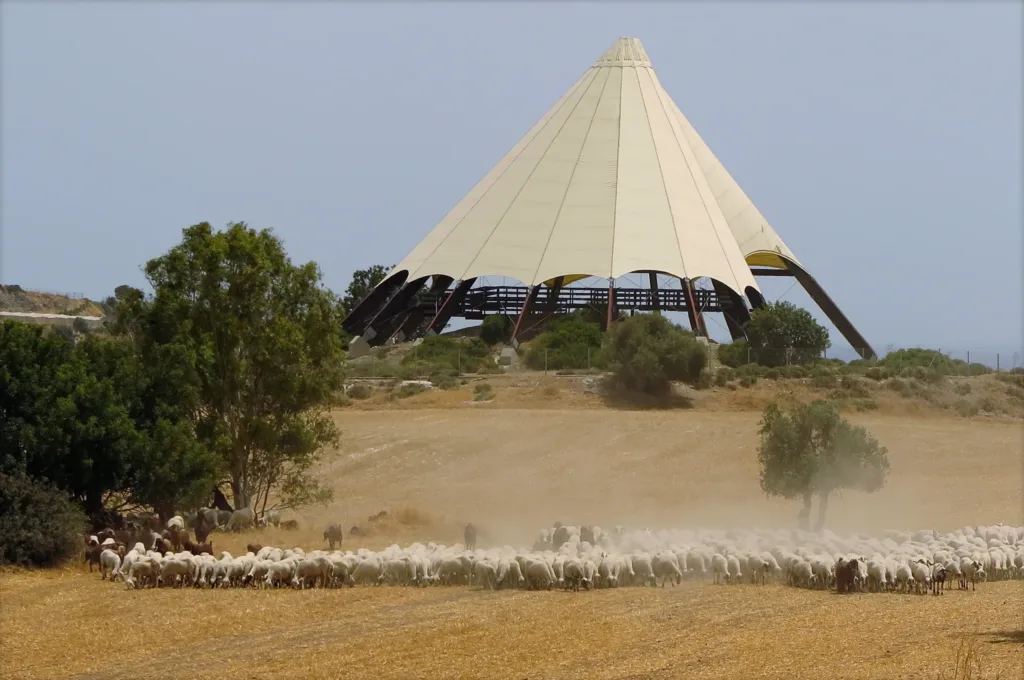
The village is known for three things: the Neolithic settlement of Tenta under its distinctive conical roof, the Bronze Age town of Kalavasos-Ayios Dhimitrios and the 20th-century copper mines, which left shafts and a narrow-gauge locomotive on the old bridge. The Kalavasos reservoir lies nearby.
Below, you’ll find what to see in and around the village, how to get there, and what to check before your trip. This is one of the few places in Cyprus where, within a small area, you can trace the island’s history from the Neolithic period to the industrial era.
Tenta: a Neolithic settlement
According to the Deputy Ministry of Tourism, the Neolithic settlement of Tenta is situated not far from the village and dates back to 7000 BC. It is one of the most significant Neolithic settlements on the island and is covered by a cone-shaped roof — a modern architectural intervention in the landscape that is visible from afar.
The Kalavasos Community Council places Tenta in the Aceramic Neolithic, approximately 7000–6000 BC. The settlement stands on a small hill above the Vasilikos River, which was easy to defend. Systematic excavations began in 1976 under the direction of Ian Todd: they uncovered circular houses built of stone and mud-brick, grouped around courtyards, storage pits, burials and an outer stone wall. The walls of the houses were covered with a thick layer of plaster, and some of the floors were coated with red ochre.
According to local tradition, the name goes back to 327 AD: the Deputy Ministry of Tourism says that Saint Helena, mother of Constantine the Great, stayed here in a tent (‘tenta’) whilst travelling to Cyprus after the discovery of the Holy Cross in Jerusalem.
Ayios Dhimitrios: a Bronze Age town
According to the local council, the settlement of Kalavasos-Ayios Dhimitrios existed from around 1500 to 1200 BC. It was a well-organised urban centre that flourished thanks to its proximity to copper deposits and the Mediterranean trade routes.
Excavations were carried out here between 1979 and 1998 as part of the Vasilikos Valley Project, led by Professor Ian Todd and Dr Alison South. They uncovered a complex urban layout and a large administrative building known as Building X.
According to the council, in addition to copper, large stocks of olive oil and wine were stored here, and the town was linked to international trade with the Aegean and the Near East. The finds help us to understand how Cyprus was organised during the Late Bronze Age.
Copper mines
Copper has been mined around Kalavasos since antiquity. According to the community council, the Mavri Sykia mine was in operation both in ancient times and in more recent times, whilst the large deposits of oxidised, ‘rusty’ rock near the Platies mine indicate intensive mining activity in ancient times.
Modern mining began in 1937 at the Mavridia mine. The Petra mine operated from 1953 to 1966 and was one of the largest in the area: during that time, 290,000 tonnes of ore were extracted there.
Today, the mines are closed, and their history forms part of the village’s heritage, which the community council presents on its website and in its virtual museum. Do not enter the old mine workings or spoil heaps unaccompanied: such places can be dangerous.
The mine railway and the train park
Ore was transported from the mines to the coast near Vasiliko via the mining company’s narrow-gauge railway. According to historical records, it operated from the late 1930s to the late 1970s and carried copper ore, pyrite and gypsum.
A diesel locomotive with wagons, situated on the old railway bridge in the village, serves as a reminder of it. The community council calls the spot the Train Community Park and suggests it as a stop on a walk around Kalavasos.
Do not confuse this short mine line with the Cyprus Government Railway, which linked Famagusta, Nicosia and Morphou and closed in the early 1950s: these are different lines with different histories.
The reservoir and its surroundings
According to the Water Development Department, the Kalavasos dam on the Vasilikos River was completed in 1985. It is a 60-metre-high rock-fill dam, and the reservoir has a capacity of 17.1 million cubic metres. The department itself publishes the current water level.
The Community Council notes that there are picturesque cycle routes around the reservoir and through the Vasilikos valley. The village is home to the Byzantine-style Church of Panagia Titiotissa, built in 1892, whilst among the chapels is the Chapel of Saint George Kefalas, whom the locals revere as a healer of headaches.
Near Kalavasos lies Choirokoitia, another Neolithic settlement, which is on the UNESCO World Heritage List. Tenta and Choirokoitia can easily be visited in one day to compare two settlements of the island’s first farmers.
How to get there and what to check
Kalavasos lies next to the Nicosia–Limassol motorway. According to the Deputy Ministry of Tourism, Tenta is 40 km from Larnaca and 2.5 km off the motorway, so it is easy to include the village in a trip between Larnaca and Limassol.
Opening hours and admission prices for Tenta are published by the Department of Antiquities and on the visitcyprus.com website: the summer and winter timetables differ, and the monument may be closed at weekends. Check these details before you travel, especially if you’re planning to visit on a Saturday or Sunday.
The Kalavasos Community Council publishes news and events from the village, as well as information on accommodation and local establishments. In summer, visit in the morning or later in the day: it gets hot in the valley, and there is little shade at the archaeological site and by the reservoir.
Continue planning
- Larnaca: what to see, where to stay and how to plan your trip
- Archaeology and UNESCO Sites in Cyprus: A Practical Guide
- Pentakomo, Cyprus: village guide, convent and white-rock coast
Official sources
- Statistical Service of Cyprus: 2021 census, population by community (table 1891108E)
- Deputy Ministry of Tourism: Kalavasos-Tenta archaeological site
- Kalavasos Community Council: Tenta
- Kalavasos Community Council: Kalavasos-Ayios Dhimitrios
- Kalavasos Community Council: the mines
The conical roof over the Neolithic settlement of Tenta near Kalavasos · Photo: Rolf Dietrich Brecher from Germany · CC BY 2.0 · converted to WebP and resized.
