Liopetri village, Cyprus: old churches, history and Potamos
About the place
Checked: 25 October 2026.
Liopetri at a glance: a Kokkinochoria village near Ayia Napa
Liopetri (Greek: Λιοπέτρι) is a village in the Famagusta (Ammochostos) district in eastern Cyprus, not far from Ayia Napa (Agia Napa). It is one of the Kokkinochoria, the ‘red-soil’ farming villages, whose main crop is the famous Cypriot potato. At the 2021 census Liopetri had 4,908 residents, which makes it one of the larger villages in the district.
Liopetri is known for several things: the nearby mouth of the Potamos tou Liopetriou river with its small fishing shelter, two old churches, a barn where a battle with British troops was fought in 1958, and its tradition of basket weaving. Besides potatoes, the farms around the village grow pomegranates and figs.
The village has had this name since the Middle Ages, and old maps show it as Ligopetri. This spelling is sometimes explained as ‘few stones’, from the Greek words for ‘few’ and ‘stone’. This is a folk explanation rather than a confirmed etymology, so we give it only as one version.
History of Liopetri: from the Middle Ages to the 1958 battle
According to Visit Cyprus, Liopetri has borne its current name since the Middle Ages. The traditional houses made of mud brick and straw, which can still be seen on its streets today, are a reminder of the village’s former appearance. They were built from local materials available on the plain.
One unusual chapter of local history involves the French poet and traveller Arthur Rimbaud (1854–1891). According to Visit Cyprus, he worked in an old quarry in neighbouring Potamos tou Liopetriou. Tourist sources do not specify the exact location of the quarry, so ask locally for details.
On 2 September 1958 a long battle was fought in a barn in Liopetri between EOKA fighters and British troops; four of the fighters were killed. Today, the barn serves as a memorial to the National Liberation Struggle of 1955–1959. Greek sources call the site Achyronas Liopetriou, ‘the barn of Liopetri’.
What to see in Liopetri
The 15th-century Church of Agios Andronikos is one of the village’s main historical monuments. Visit Cyprus singles out its octagonal dome. If the church is closed, ask the parish or the community council whether it can be visited.
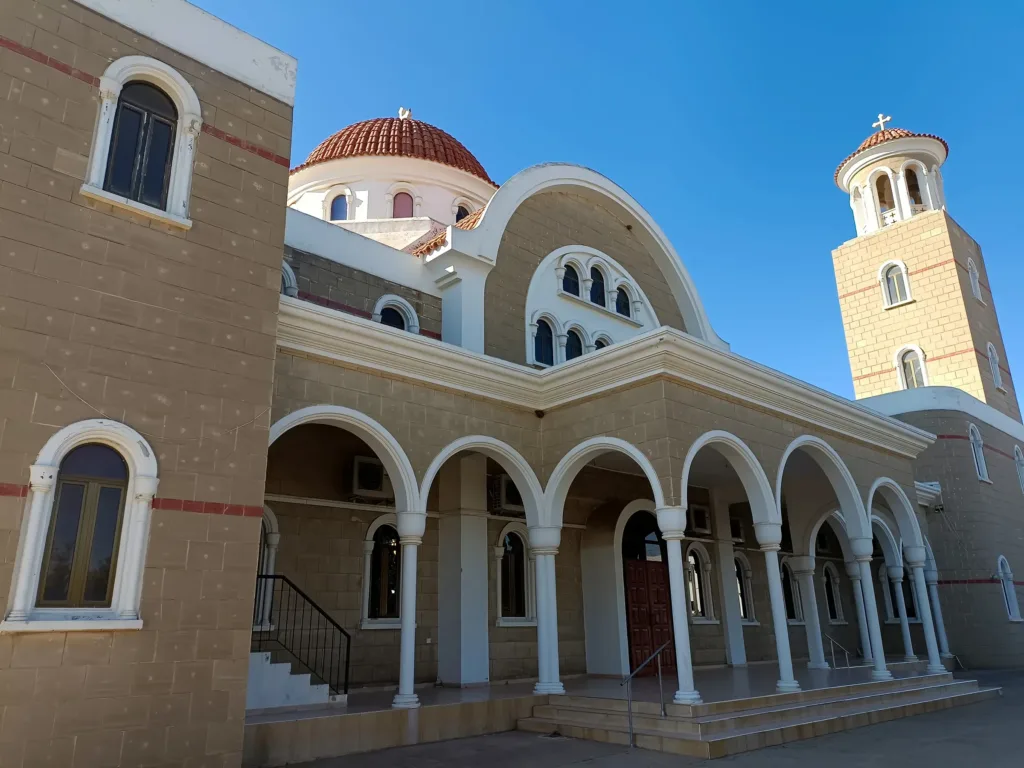
The small domed 16th-century church of the Virgin Mary is Liopetri’s other historic church. Its feast day is 15 August, the Dormition of the Virgin Mary, and, according to Visit Cyprus, traditional festivities take place in the village on that day.
The barn memorial is a place of remembrance rather than a sightseeing attraction, and visitors are expected to behave with restraint there. As you walk through the village, look out for the traditional houses of mud brick and straw – a distinctive feature of Liopetri’s old buildings.
Traditions in Liopetri: baskets, potatoes and festivals
Liopetri is one of the Cypriot communities where basket weaving with wicker and reed was practised as a trade. The Cyprus National Commission for UNESCO names Mesogi, Liopetri and Livadia in this respect. The craft is included in the Cyprus inventory of intangible cultural heritage under traditional craftsmanship.
The baskets are made from reed, wicker or straw, and very few tools are needed. To watch basket makers at work or buy a basket, ask the community council who still practises the craft and whether any demonstrations or fairs are being held.
The red soil of the Kokkinochoria suits potatoes, which are grown in the fields around the village. As well as potatoes, Liopetri is known for its juicy pomegranates and figs. The village’s biggest festival falls on 15 August, the feast day of the church of the Virgin Mary.
The sea nearby: Potamos tou Liopetriou fishing shelter
Potamos tou Liopetriou is the river mouth near the village, where there is a natural fishing shelter. Visit Cyprus lists it among the fishing shelters and small harbours of the Famagusta district; such shelters are maintained by the Department of Fisheries and Marine Research. It is a working mooring for fishing boats, not a beach.
Potamos and Liopetri lie on the Visit Cyprus cycling route ‘Ammochostos 1 – Agia Napa – Pyrgos Xylofagou’ (Xylofagou tower). It starts at Ayia Napa harbour, passes the Potamos tou Liopetriou fishing shelter, the medieval Xylofagou tower and the village of Xylofagou, and then returns to Ayia Napa via Liopetri. The circuit is 38.1 km long.
Visit Cyprus describes the route as easy, but recommends a 21-speed mountain bike. According to the route table, Potamos tou Liopetriou comes at about kilometre 11 from Ayia Napa harbour and Liopetri at kilometre 24. For swimming, choose a beach from the list of organised beaches on the Visit Cyprus website.
Getting to Liopetri and planning your visit
Liopetri is easy to reach by car from Ayia Napa, Protaras or Larnaca. The village and the mouth of the Potamos tou Liopetriou are separate places and you have to drive from one to the other, so mark both on the map in advance.
Buses to the villages in the Famagusta district run to their own timetable, which changes with the seasons. If you plan to travel without a car, check with the district’s public transport operator to find out which services currently stop at Liopetri and when the last return bus leaves.
A few hours are enough for the village, the churches and the barn memorial. You can combine the trip with a walk at the fishing shelter and a look at Xylofagou tower, which is marked on the same cycling route. In the hot months, morning or evening is the best time.
What to check before visiting Liopetri
The historic churches in Liopetri are not always open. Ask the parish or the community council about service times and whether you can look inside. If a service is in progress, wait until it has finished before looking around the church; clothing must cover the shoulders and knees.
The barn memorial marks the place where people died. Loud conversation and staged photo shoots are out of place here. If you would like to find out more about the events of 1958, ask the community council whether guided visits or commemorations are held.
Local fishermen work at the fishing shelter. Please do not block boat ramps or access roads, do not board boats without being invited, and do not take close-up photographs of people without their consent. If you want to go out to sea, choose licensed operators and ask them about the conditions and safety rules.
Continue planning
Official sources
- 2021 Population Census — Cyprus Statistical Service (CYSTAT)
- Liopetri village — Visit Cyprus
- Basketry and straw-mat making — Cyprus National Commission for UNESCO
- Ammochostos 1 cycling route (Agia Napa – Pyrgos Xylofagou) — Visit Cyprus
The new church of the Virgin Mary in Liopetri · Photo: Knowledge2need · CC BY-SA 4.0 · converted to WebP and resized.
