Cypriot Pottery: Craft, History and Shopping
Historical and contemporary Cypriot pottery: how a workshop operates, how to choose tableware and how to distinguish between functional and decorative pieces.
Checked: 24 September 2026.
Ceramics as a craft and an everyday object
Cypriot ceramics encompass archaeological heritage, the work of contemporary workshops and everyday tableware. These themes are linked by the material and the skills involved, but should not be conflated into a single narrative of an ‘unchanging ancient recipe’. A contemporary artist may draw inspiration from an old form whilst creating a new piece for today’s home.
Shops stock decorative vases, tiles, ornaments and tableware. Items that look similar may be handmade, moulded or mass-produced. To understand what you are buying, ask about the workshop, the material, the glaze and the intended use; a pattern on the surface is not proof of being handmade.
Archaeological artefacts help us to understand the island’s long history of working with clay. However, an ancient artefact in a museum and a modern cup are subject to different criteria for evaluation and use. One should not apply a museum’s technical classification to a souvenir without an explanation from the artisan or supporting documentation.
Where to explore history
Museums and official cultural institutions present historical artefacts within the context of place, time and archaeological excavations. A caption for an exhibit is more important than a similar image found online: it explains what researchers know and where questions remain. Before your visit, check opening hours and current exhibitions.
The official tourism portal publishes material on ceramics and local crafts. This is a good starting point for understanding contemporary production, but the existence of a specific workshop and programme needs to be confirmed separately. Not every public address means free access to the working area.
At an exhibition, it is useful to compare the purpose of the objects: storage, cooking, decoration or ritual. Form is often linked to function, whilst ornamentation is linked to the era and location. Avoid drawing definitive conclusions based on a single motif: a similar pattern may appear in different periods and by different artists.
How a modern pottery workshop operates
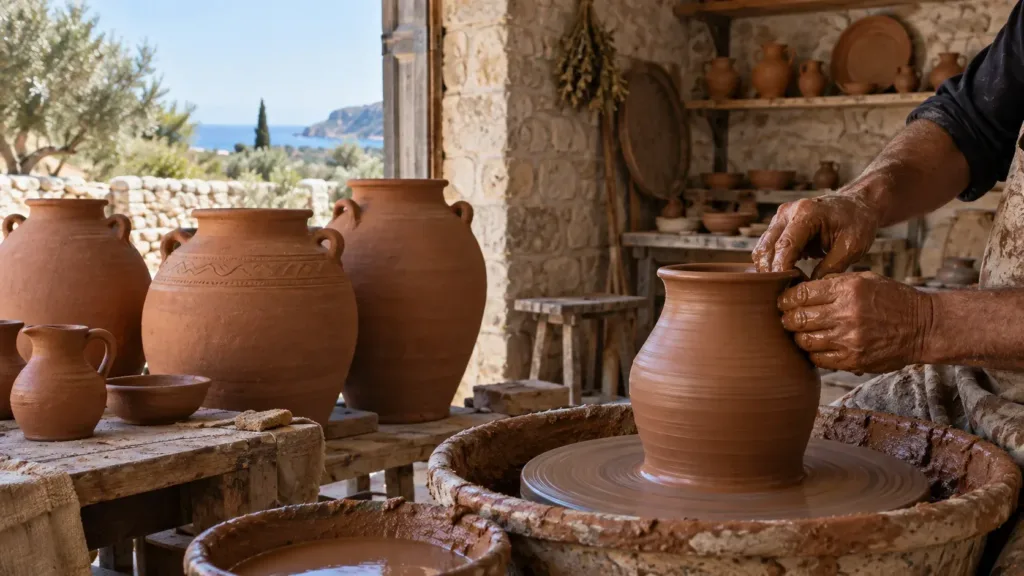
The potter selects the clay, shapes the object, dries it, fires it and, if necessary, applies a glaze. Changes in shape and colour are possible at every stage. A slight irregularity is sometimes a sign of handcrafted work, but a crack, a sharp edge or a fragile handle requires careful consideration before purchase.
The potter’s wheel is one method of shaping, but not the only one. An item can be sculpted, assembled from layers or cast in a mould, and then hand-painted. If it is important to you to know exactly which steps the craftsman has carried out, ask to be shown the process and do not accept ‘handmade’ as a substitute for an explanation.
Decorative glazes and glazes for tableware must meet different standards. A beautiful sheen does not mean that the piece is suitable for food or hot drinks. Check the intended use with the manufacturer and look for explicit information regarding food safety.
Choosing tableware and gifts
For cups, plates or bowls, check that they are stable, that the rim and handles are comfortable to hold, and that the surface is easy to clean. Ask whether the item is suitable for the dishwasher, microwave and hot food. If no answer is provided, treat the item as decorative, particularly if the glaze is unknown or there are cracks.
For vases and home décor items, other factors are important: does it hold water, is the base stable, and does the base scratch the furniture? Dried flowers and fresh flowers require different care. A quick check of its practical suitability will save you from disappointment once you get home.
Check the artist’s name, place of manufacture and whether it can be reordered. A souvenir featuring an image of the island may be imported; this does not make it unsuitable, provided the price and description are honest. If you wish to support a local workshop, ask for specific confirmation of the item’s origin.
Price and quality
The price of handmade ceramics is determined by the time, materials, firing processes, wastage and the shop’s overheads. You cannot accurately judge the cost to the craftsman based solely on the size of the item. Compare the quality of the finish, the stability and the explanation of the technique, rather than just the weight and the amount of paint on the surface.
Examine the surface in good light. Run your finger along the edge without applying too much pressure: it should not be dangerously sharp. For tableware, check for cracks and areas where the glaze is peeling off. Minor traces of the handmade process are acceptable, provided they do not interfere with the item’s intended use.
Ask for a receipt and written return policy, particularly for expensive pieces or bespoke orders. If the item is being made specifically for you, agree on the dimensions, colour range, lead time and delivery arrangements in advance. After firing, the shade may differ from the unfired sample; the craftsman should explain this before you confirm the order.
Transport and Care
Ceramics are fragile. For travel, ask for packaging that protects the edges and fills any gaps, and at home, check the item is intact before removing all packaging materials. If the item is being sent by post, agree on insurance cover and the procedure to follow in the event of damage. A photograph of the packaged item may be helpful, but is no substitute for clear delivery terms.
Wash the item using the method recommended by the craftsman. A porous, unglazed surface may absorb moisture and odours, whilst decorative painting may require gentle cleaning. Do not apply advice intended for mass-produced tableware to a handmade vase without first checking the material and finish.
If the item has cracked, stop using it for hot food or water until a specialist has assessed whether it can be safely repaired. Decorative restoration does not always restore the item’s suitability for food contact. Keep the craftsman’s details: they may be able to advise on appropriate care and repair.
A tour of workshops
Start with official cultural resources and select a few workshops where you can observe the process. Check the booking details, address, language of the tour and rules for children. Working with kilns, dust and tools requires visitors to stay within the workshop boundaries; visitors must not enter the production area without invitation.
Once there, ask what items are made there, how they were fired and what they are intended for. If a workshop is on offer, find out whether firing is included in the price and when you can collect the finished piece. Unfired pieces do not become finished souvenirs immediately after the session.
The sources for this page were checked on 24 September 2026. Exhibitions, workshops and product ranges are subject to change, so please confirm your travel plans with the organisers. Cypriot ceramics are particularly interesting for the diversity of their past and present; clear information about their origin and purpose helps you choose a piece that will last a long time.
Continue planning
- Lefkara lace: the craft and choosing a souvenir
- Commandaria: origins, flavour and choosing a wine
- Halloumi: Cypriot cheese, origins and cuisine