Lefkara lace: the craft and choosing a souvenir
What is Lefkaritika, how is hand-made lace created, what does UNESCO recognition mean, and how to choose a piece in Lefkara.
Checked: 24 September 2026.
What is Lefkaritika
Lefkara lace, or Lefkaritika, is associated with the village of Lefkara and the tradition of hand-embroidery. This craft is recognised by its combination of geometric patterns, cut-out elements and meticulous finishing of the fabric. However, items of different origins and manufacturing methods may be sold under the same tourist-oriented name.
UNESCO has included Lefkara lace on its list of Intangible Cultural Heritage. The focus of this recognition lies on the skills of the craftspeople, the training and transmission of techniques, rather than a certificate for every napkin in a shop. It is important for buyers to distinguish between a documented tradition and the marketing claim of an ‘authentic UNESCO product’.
The craft has stories to tell about trade, travellers and famous commissions. Some of these are recounted as legends; they should not be treated as proven facts without documentary evidence. It is far more interesting to talk to the artisan about how she chooses a design and how many steps are required for a particular piece.
How the piece is created
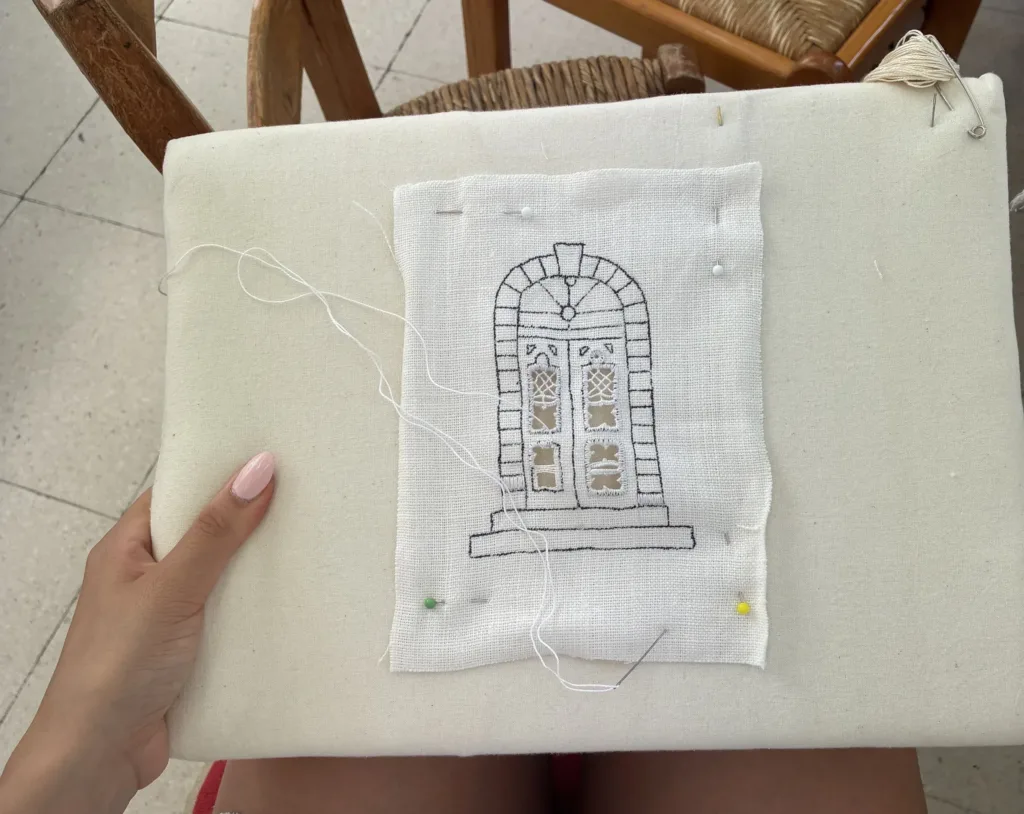
The work begins with the fabric, marking out the design and a well-thought-out pattern. The artisan then executes the stitches, cut-out sections and finishing touches, ensuring the elements are repeated consistently. The viewer sees the finished, symmetrical piece, but does not always realise the time required to achieve a neat edge and consistent thread tension.
Size does not equal labour intensity. A small, intricate insert may require more attention than a large piece with a simple repeating pattern. If the price seems unexpected, ask to see the reverse side and have the technique explained; a discussion about a specific piece is better than a general comparison ‘per metre of fabric’.
Contemporary craftspeople may incorporate traditional motifs into new items: clothing, home textiles or small gifts. This does not make the item any less interesting, provided the seller honestly describes which stages were done by hand and which by machine. What matters more is transparency regarding the item’s origins, the quality of the workmanship and respect for the artist’s labour.
Handmade items and mass-produced souvenirs
Shop windows display hand-made, machine-made and mixed-technique items. A photo taken from a distance does not allow you to reliably determine the technique used. Examine the stitches, the edge, the reverse side, and the repetition of the pattern, and ask who made the item. Excessively perfect uniformity may be a clue, but is not in itself a sign of expertise.
The word ‘Lefkara’ on the price tag may refer to the place of sale, the style of the design or the item’s origin. Clarify exactly what the seller is promising, especially if the price reflects handcrafting. A receipt bearing the shop’s name is useful, but for an expensive item it is worth asking for written details about the maker and the materials.
A cheap, machine-made souvenir may be a suitable choice if you understand what you’re buying. The problem arises when it’s passed off as the work of a specific artisan. Compare several shops and workshops, and don’t assume that any item in a tourist village is automatically made there.
A trip to Lefkara
The village is known for its narrow streets, workshops and craft shop windows. A visit may include a stroll and a chat with the craftspeople, but opening hours vary depending on the season and day of the week. If you’d like to see a demonstration of the craft, contact your chosen workshop in advance rather than relying on an outdated itinerary from a guidebook.
When visiting, please ask permission before taking photographs of people or work in progress. Watching the craft in action is enjoyable, but the workshop remains a workplace. If you do not intend to buy anything, you can honestly express your interest in the craft and enquire whether there is a public tour or a museum programme.
Don’t limit your exploration to just one souvenir street. Official cultural resources help you understand the history and the region, whilst a conversation with a local artisan offers a contemporary perspective. Comparing sources is particularly important where a tourist legend has long since become a commercial slogan.
How to choose something for your home
First, decide whether you need a decorative napkin, an item for everyday use, or a piece of textiles as a gift. The fabric composition, size and care instructions influence your choice just as much as the design. Hold the item up to where you intend to place it: delicate handiwork may get lost against a background that is too busy.
Check the edges, symmetry, neatness of the stitching and that there are no stains. Handmade items may have slight individual variations, but any fabric defects or fraying should be discussed before payment. If the item is expensive, ask to have it measured and make a note of the return or exchange policy.
If buying a gift, check the material and washing instructions so the recipient can look after the item. A small item with a clear story behind it is often more valuable than a large, anonymous souvenir. The packaging should protect the fabric from moisture and dirt, especially if the journey involves several changes.
Caring for lace
Proper care depends on the fabric, threads, dyes and the age of the item. Follow the maker’s instructions or the label. For an old or particularly valuable item, standard machine washing may be risky; consulting a textile specialist is wiser than relying on general advice from a travel article.
Store lace in a dry, clean place, avoiding prolonged exposure to direct sunlight and contact with rough surfaces. If an item is left folded away for a long time, check its condition from time to time. Do not use strong bleaches without first testing the fabric: damage to the fine threads may be irreversible.
Before buying a vintage item, ask about any repairs or stains. Signs of age do not always render an item unusable, but the buyer should be fully aware of them. If the seller claims the item is a rarity or comes from a museum, ask for proof; a verbal account is not sufficient for a high-value attribution.
What to do after your purchase
Keep a record of the artisan’s name, the workshop’s contact details and a description of the technique used. This information transforms a souvenir into a meaningful item with a traceable provenance. If the item is a bespoke commission, agree on the size, deadline, design and payment in writing to avoid any disputes.
UNESCO and cultural institutions describe a living tradition, rather than freezing it into a single pattern. New forms can keep the craft alive, provided the artisan masters the technique and is honest about the process. Supporting local craftsmanship begins with asking respectful questions about the work, rather than simply seeking the lowest price.
The sources for this page were verified on 24 September 2026. Please check the availability of workshops, prices and visiting arrangements before travelling. Lefkaritika deserves attention both as a skill and a cultural practice; when choosing a specific item, check the maker, materials, technique and care instructions.
Continue planning
- Cypriot Pottery: Craft, History and Shopping
- Commandaria: origins, flavour and choosing a wine
- Halloumi: Cypriot cheese, origins and cuisine