Folk dances of Cyprus: names, performance and etiquette
Kartchilamas, syrtos and live performances: how to watch Cypriot folk dances, choose a performance or a lesson, and participate respectfully in the festivities.
Checked: 3 October 2026.
How to understand the folk dances of Cyprus
Cyprus’s folk dances are a living tradition that can be seen at family celebrations, community events and performances by dance groups. When encountering them for the first time, it is helpful to know the name of the dance, the occasion and the line-up of performers. A single performance on a tourist stage does not automatically represent all the island’s traditions.
The descriptions of the repertoire provided by the Cyprus National Commission for UNESCO primarily highlight the Greek Cypriot music and dance scene. There are various communities and traditions on the island; they cannot be reduced to a single costume or have a foreign custom declared a variant of a single, mandatory national model.
Dance helps to express the relationships between people, the mood and the performer’s skill. This provides a useful starting point for the audience: look not only at the steps, but also at how the dancers interact with the musicians. The question ‘what is happening between the performers’ often explains a routine better than trying to guess how old it is.
Kartchilamas and pair interaction
Kartchilamas is an important part of the Cypriot repertoire described here: the dancers stand facing one another. The name itself is derived from this arrangement. When watching the dance, pay attention to the reciprocal movements and the distance between the dancers: the interaction here is not merely a mechanical repetition of identical steps.
In traditional performances, individual style and improvisation are evident. On stage, a group may present a more uniform performance for the audience. This difference does not automatically mean that one version is authentic and the other incorrect; it simply reflects different conditions of performance and the transmission of skill.
Sources describe the historical forms of various men’s and women’s couple dances. This information should not be taken as a rule of conduct at a modern festival. If the organiser invites the audience to take part, follow their instructions rather than attempting to recreate the customs of a bygone era on your own.
Syrtos and familiar names
Syrtos features in instructional materials on Cypriot dances. The names of the dances may be familiar from other Greek regions, but the local style of performance, music and sequence of movements warrant closer attention. A mere coincidence of names is not sufficient to claim that all variants are entirely identical.
If you hear an unfamiliar name, ask the presenter or a participant to write it down and explain which version is being shown. Latin transliterations can vary, so it is useful to note down the Greek spelling as well. This makes it easier to find the lesson or recording later, without having to guess the dance from the costume.
The sirtaki, well known from popular culture, should not be used as a catch-all term for any dance in Cyprus. If you are unsure of the name, it is best to describe what you have seen in simple terms. A recognisable melodic fragment does not, either, prove the origin of the entire dance or that it has remained unchanged over time.
Music, costume and stage performance
Musicians play an active part in shaping the dance, rather than simply providing a backdrop for the movements. Listen to how the performer responds to the phrase and rhythm, how they vary the pattern, and how they bring the section to a close. These connections are easier to spot in a live performance than in a short video clip with no clear beginning or end.
Costumes help to convey the cultural context, but do not in themselves provide an accurate date for the dance. A dance troupe may choose costumes for a specific programme, region or stage production. If you are interested in the history of the costumes, ask about the source of the reconstruction rather than drawing conclusions based on the colour of the fabric or the style.
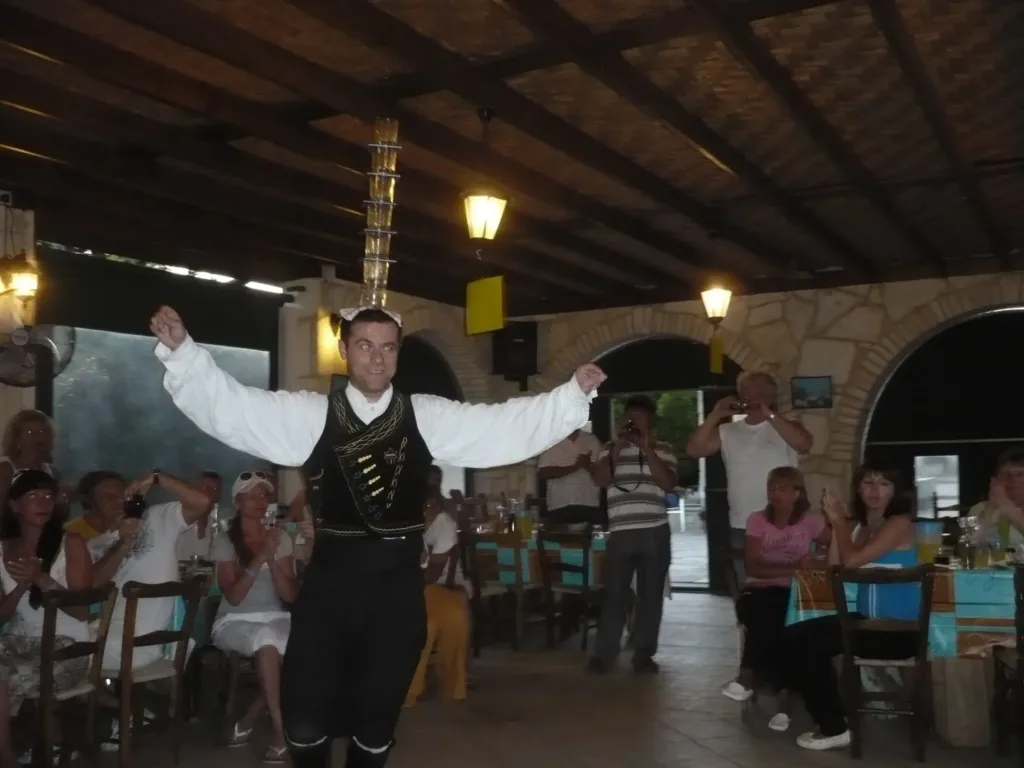
The repertoire includes acts that showcase agility and the use of props. Do not attempt to imitate them near the stage or without proper training: spectacular does not mean simple. It is best to view a dance routine with props as a prepared performance, rather than an invitation to a casual competition.
Where to watch and how to choose an event
A suitable option is the programme for a cultural association, a local event or a festival that lists the group. Such announcements help you to understand the duration, venue and nature of the performance. The phrase ‘traditional music’ does not always mean a dance performance, and a restaurant’s name is no substitute for a programme.
For a more in-depth experience, a short talk with explanations is more worthwhile than the promise of seeing ‘the whole of Cyprus’s heritage’ in a single evening. Check whether there will be a presenter, whether a meet-and-greet with the performers is planned, and whether audience participation is possible. Not every concert doubles as a dance lesson.
Dates and line-ups are subject to change. Please check the year on the poster and the organiser’s latest announcement, especially if you’re planning a trip specifically to see a particular act. Archive footage shows the repertoire, but does not confirm that the same troupe is performing today at the same venue or in the same programme.
Etiquette for spectators and participants
At a family gathering, first ask whether it’s appropriate to join in. Even an open space and music do not turn a private event into a public masterclass. If you’ve been invited, follow the lead and leave room for the more experienced participants; quietly observing is also a respectful way to get to know people.
During the performance, please do not obstruct the performers’ movements or step onto the stage just to take a photograph. Please check with the organiser and the participants before taking photographs of people, particularly children. A brief chat after the performance is usually more appropriate than trying to ask a dancer questions whilst they are still performing.
During the lesson, let the teacher know your level and ask which routine to start with. The teacher may suggest a simple movement or observing one part of the routine. Mistakes are natural for beginners; comparing your performance to a professional stage recording won’t help you understand the rhythm and interaction during your first lesson.
A tradition that continues to evolve
Cultural associations and teachers preserve the repertoire, teach children and adults, and work on music and costumes. At the same time, the process of passing on this tradition also involves observing experienced dancers in their everyday lives. These approaches complement one another: a structured lesson does not negate family memory, nor does memory replace explanation.
Dance should not be described as a fixed set of movements that has been handed down uninterrupted from some ancient time. Sources speak of interactions, reinterpretations and variations in performance. Where origins are disputed or unconfirmed, an accurate name and description of contemporary practice are more useful than a spectacular legend.
After watching, make a note of the name of the group and the dance, the occasion, and your own observations about the music. That way, your experience remains linked to specific people and the event itself. You can then choose your next performance more thoughtfully: to see a different version, to speak to the teacher, or to take an introductory lesson rather than simply repeating the same stereotype.
Continue planning
- Cyprus Festivals: A Seasonal Calendar of Events
- A leisurely 3-, 7- and 10-day itinerary around Cyprus
- Public holidays and opening hours in Cyprus
Official sources
- Cyprus National Commission for UNESCO — traditional dances
- Cyprus diaspora government portal — traditional dances
Dance performance in Cyprus · Photo: OldMuzzle · CC BY-SA 3.0 · converted to WebP and resized.
