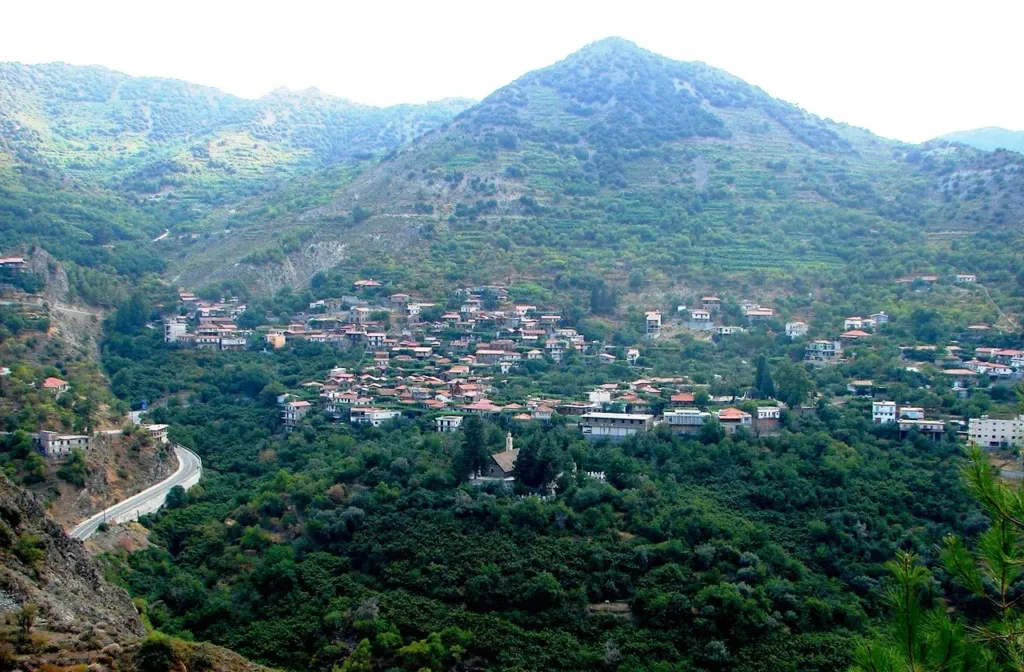
Alona village, Cyprus: hazelnut valley of Pitsilia and how to visit
About the place
Checked: 29 October 2026.
Alona at a glance: a hazelnut village in Pitsilia
Alona (Greek: Άλωνα) is a mountain village in the Nicosia district, in the Pitsilia region (Πιτσιλιά) on the northern slopes of the Troodos. According to the community council, it lies between the peaks of Madari and Papoutsa at about 1,200 m above sea level and has been known since the early years of Frankish rule. Visit Cyprus, the official portal of the Deputy Ministry of Tourism, puts Nicosia 53 km away.
According to the 2021 census, the village has 39 residents. The community council says that few people stay in Alona in winter, while in summer people from the village return to their family homes. The official Greek name of the village is Άλωνα.
Alona is known for its hazelnut valley, the vine canopies over its streets, a nature trail through the orchards and its autumn zivania festival. This page covers the village itself and its immediate surroundings; neighbouring Agros and Kyperounta have their own pages on our site.
History of Alona and local legends
The community council traces the earliest records of the village to the Frankish period. According to local tradition, Alona then belonged to a Frankish king, and the Franks themselves spent their summers here. One part of the village is called Perrou: the council links the name to King Peter, who, according to tradition, owned the village in the Middle Ages.
Above the village rises a mountain that locals call Moutti tis Kandilas, ‘the peak of the oil lamp’. According to tradition, an icon of the Virgin is hidden there with a lamp before it that never goes out, and old villagers used to say they had seen its light at night.
The old quarters keep their stone houses and narrow lanes paved with mountain stone; according to the council, the paving was relaid in the 1940s. Beneath the quarters run underground passages known as ‘katerka’: one theory holds that they are the remains of ancient ore workings, another that they were refuges in times of danger.
Hazelnuts, orchards and vine canopies
Alona’s hallmark is the hazel tree and its nuts, known in Cypriot Greek as ‘leftokarka’. The community council says that in Cyprus hazelnuts are grown only in Pitsilia, and above all in Alona, and that the valley below the village is almost entirely planted with hazelnut trees. Neighbouring Polystipos is also known for its hazelnuts: the Department of Forests describes a separate trail there through a hazelnut grove.
According to the council, fruit ripens in Alona seven months of the year, from cherries in May to late grape varieties in November. The Department of Forests notes dense plantings of cherry, apple and almond trees around the village. Visit Cyprus adds that the village makes zivania, the Cypriot grape spirit.
Another hallmark of Alona is its vine canopies. According to the council, almost every house has one, and from the village entrance to the square, a distance of about 600 m, the street runs under a roof of vines. The old quarters still have carved doors by the local craftsman Hadjigiorgis Mourmouris, who worked in the second half of the 19th century.
The churches of Alona
The village’s main church is dedicated to St George. According to the community council, it stands on the site of an earlier church that burned down in the early 1830s. The church was later enlarged and is now a three-aisled basilica with a timber roof. Its façade is decorated with carved reliefs by the teacher and artist Christodoulos Kantos, father of the painter Telemachos Kantos.
Among the church’s treasures the council lists a 1641 icon of St George in a silver cover and an icon of the Virgin Galaktotrofousa (the Virgin nursing the Child), to which, according to tradition, young mothers came from all over the island. The church also keeps a gold-embroidered epitaphios from the late 19th century which, according to the council, came from Russia. Visit Cyprus notes that a large feast in honour of St George is held in the square on 3 November.
About a kilometre north-west of the village, by the old path to Nicosia, stands the chapel of Panagia Kardakiotissa. The council and Visit Cyprus date it to the 15th century. A fire in 1987 destroyed its revered icon of the Virgin, and the chapel itself was later restored. The council now lists two old icons from the chapel among the treasures of St George’s church.
The Petros Vanezis trail and the surrounding area
The Petros Vanezis trail starts right in the village. According to the Department of Forests, it is a 1.5 km circular route that takes about half an hour. It has two starting points on the main street: by the co-operative bank and about 300 m further south, by the church. The trail passes through cherry, apple and almond orchards and descends to a stream within a Natura 2000 site.
The Department of Forests places the trail in the highest, third difficulty category on its three-grade scale. According to the community council, in spring violets flower and ferns grow under the trees, in summer almost the whole route is in shade, and in autumn nuts lie underfoot and the small white Pitsilia cyclamens are in flower.
In neighbouring Platanistasa stands the church of Stavros tou Agiasmati, one of the ten painted churches of the Troodos on the UNESCO World Heritage List. Visit Cyprus includes Alona in the Pitsilia wine route together with Polystipos, Agros and Kyperounta; according to Visit Cyprus, Polystipos is just 3.5 km away.
How to get to Alona and plan your visit
The easiest way to get there is by car. From Nicosia, Visit Cyprus suggests taking the E902 and then the E903. The community council names two approaches: from the Platanistasa side, or via Palaichori and Fterikoudi. Pitsilia roads are mountainous and winding, so allow extra time.
From Limassol you can follow the chain of villages on the Visit Cyprus wine route, via Pelendri, Kyperounta, Chandria and Polystipos. Buses to the mountain villages are infrequent, so check the timetable and the return service with the operator in advance.
Half a day is usually enough for the village, the trail and the church. Visit Cyprus mentions accommodation and restaurants in Alona, so you could also stay for the weekend and add Platanistasa, Polystipos, Agros and the climb to the summit of Madari.
What to check before visiting Alona
Festival dates change from year to year. In summer, the village’s sports and cultural club has held an annual festival since 1972, with plays, dance evenings and talks. The zivania festival is usually held on a Sunday in late October or early November; in autumn 2026 it has already taken place, at the end of October. Check the exact programme with the community council.
St George’s church and the chapel of Panagia Kardakiotissa are not always open, so check visiting times with the community council or the parish. The usual church etiquette applies: covered shoulders and knees, quiet voices and no photography during services.
As the Department of Forests points out, trails outside state forests are maintained by local authorities, so ask the community council about the condition of the trail. In winter there can be snow and ice here, and in summer the fire risk is high: do not light fires and carry water.
Continue planning
- Agros: a stroll through the village, crafts and an itinerary
- Kyperounta, Cyprus: altitude, sights and Kyperounda Winery
- Troodos: villages, trails and routes through the mountains of Cyprus
Official sources
- Statistical Service of Cyprus: Census of Population 2021, population by community
- Alona Community Council: history of the village
- Alona Community Council: what to see
- Visit Cyprus: Alona village
- Cyprus Department of Forests: nature trails outside state forests
- UNESCO: Painted Churches in the Troodos Region
Alona on its slope above the hazelnut valley, Pitsilia · Photo: An. Antoniou · CC BY-SA 3.0 · cropped, converted to WebP and resized.
