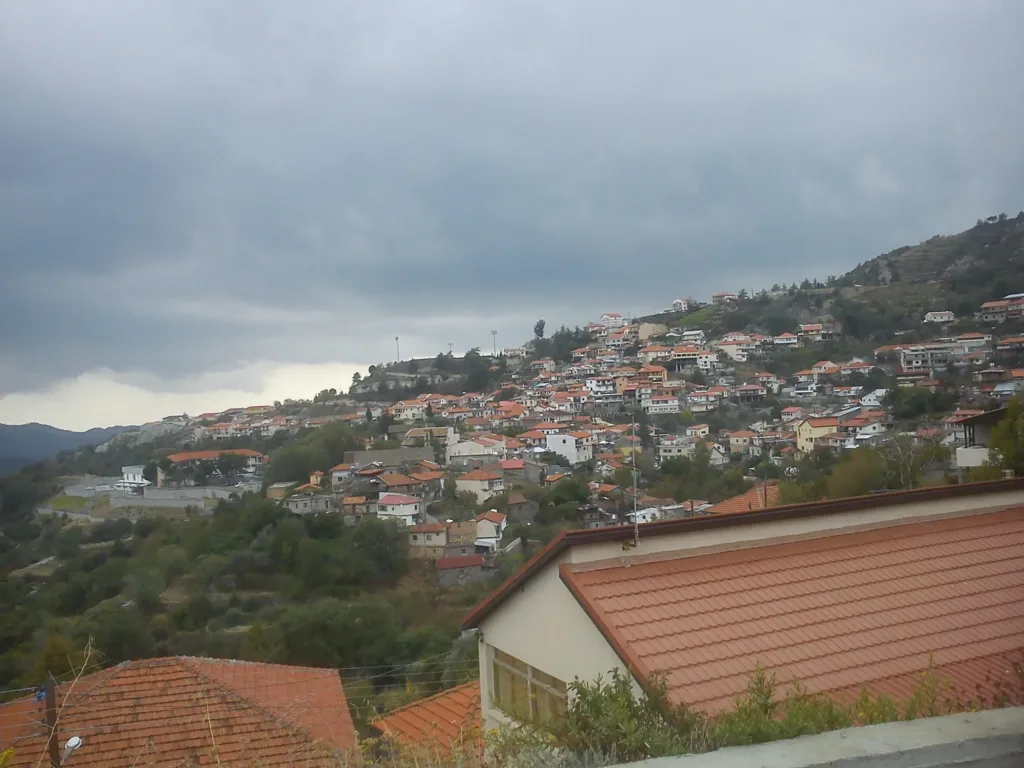
Kyperounta, Cyprus: altitude, sights and Kyperounda Winery
About the place
Checked: 25 October 2026.
Kyperounta at a glance: altitude, population and what it is known for
Kyperounta (Greek: Κυπερούντα) is the largest village in the mountainous Pitsilia area of the Limassol district, on the slopes of the Troodos Mountains, about 43 km north of Limassol. According to the community’s own description, it lies about 1,140 m above sea level; at the 2021 census it had 1,372 residents. The village is known for its apple orchards, Kyperounda Winery and the chapel of the Holy Cross with frescoes of 1521.
Sources give different altitudes because the village stretches up the hillside. Visit Cyprus gives about 1,300 m and counts Kyperounta among the highest villages on the island. The figure of 1,140 m comes from the community’s own description.
Visit Cyprus describes Kyperounta as a village of steep streets, grapevines, small yards and tile-roofed houses. The altitude means cool summers and, in winter, snow and ice on the roads. On the road from the village to Troodos Square stands the district hospital, a former sanatorium: according to Visit Cyprus, it serves 25 surrounding communities and has an emergency department.
History of Kyperounta and its name
The name is linked with the plant kyperos (κύπερος, Cyperus rotundus, nut grass), a weed that grows widely in the area and was used as animal fodder. Both Visit Cyprus and the community’s own description give this explanation.
The village is believed to have been founded during the Byzantine era. In the Frankish period it is recorded as the royal estate of Chiperonda, the name used by the historian Louis de Mas Latrie. The village is also marked on Abraham Ortelius’s map of 1573.
In the Ottoman period the Kouris river divided the village into two quarters, with the churches of Agia Marina (St Marina) and the Virgin Mary as their landmarks. Today Kyperounta is the main settlement of Pitsilia, through which roads lead to Troodos Square and to the neighbouring mountain villages.
What to see in Kyperounta
The main monument is the small single-nave stone chapel of the Holy Cross (Timios Stavros) with a wooden roof, the oldest chapel in the village. According to All About Limassol, it has stood on this site since the time of Frankish rule, and the frescoes on its eastern and western walls date from 1521. Visit Cyprus notes its unusual, uneven wooden roof, shaped like the letter L.
Since 1995 the chapel has served as an exhibition hall for the community’s church heirlooms, with icons and liturgical objects on display. It stands a few steps from the central square, among the greenery of the botanical garden. The chapel’s feast is the Procession of the Holy Cross on 1 August, at the start of the Dormition Fast.
Among other churches, Visit Cyprus names the 18th-century church of Agia Marina and the large new church of Agios Arsenios; the village also has a church of the Virgin Mary. There are three small museums: natural history, folk art and the National Liberation Struggle of 1955–1959.
Apples, wine and festivals
Most residents work in farming, above all fruit growing. The altitude and cool climate suit apples, pears, apricots, cherries, plums and peaches, and Kyperounta is considered one of the main apple-growing areas of Cyprus.
Every October, the village hosts the Apple Festival: an open-air market, an exhibition of apple varieties grown in Cyprus, products made from them, and a programme of entertainment. The festival has been held for many years, and the dates are announced separately each year.
There are vineyards around the village too, and Kyperounda Winery, part of the Photos Photiades Group, operates in the village itself. According to the winery, it is situated in the Pitsilia region, approximately 50 km from Limassol and 75 km from Nicosia, at about 1,200 m. The address given on the winery’s website is: 102 Griva Digeni Avenue, 4876 Kyperounda. Check visiting and tasting arrangements with the winery itself.
Walks, nature and the surrounding area
Kyperounta lies at the foot of the Madari ridge, which offers wide views over the mountains. Visit Cyprus lists two nature trails near the village: ‘Doxa soi o Theos’ and ‘Teisia tis Madaris’.
The linear trail from Doxa soi o Theos to the fire lookout on Madari starts about 2 km from Kyperounta, on the Kyperounta–Spilia road, at about 1,338 m. It is about 3.8 km long and takes roughly 2 hours; its difficulty on the Visit Cyprus scale is 3, and the highest point is about 1,609 m.
From Kyperounta it is easy to drive to Troodos Square and to neighbouring Pitsilia villages such as Chandria and Agros. Winter holidays and the high mountains around Mount Olympus are covered in separate articles on our site, so here we only note that the road to Troodos Square passes through the village.
Getting to Kyperounta and planning your visit
Kyperounta is about 43 km north of Limassol, and the easiest way to get there is by car. The Visit Cyprus circular route ‘Celebrating the Vine’ reaches the village from Agros via Chandria and continues to Troodos Square.
The mountain roads here are steep and winding; snow and ice are possible in winter. Before travelling during the colder months, check the forecast and updates on mountain road conditions, and at any time of year allow extra time for the journey.
The Holy Cross chapel, the village centre and one of the museums take a few hours. In autumn, during apple season and the Apple Festival, the village is particularly lively; in spring the orchards are in bloom, and in summer people come here to escape the heat.
What to check before visiting Kyperounta
Opening hours of the museums and the Holy Cross chapel change, so check them in advance with the Kyperounta community office. The Apple Festival dates are also announced separately each year: watch the Visit Cyprus events calendar and community announcements.
If you plan to visit Kyperounda Winery, check on its official website, or through the contacts given there, whether it receives visitors and whether booking is needed. Do not drive after a tasting. Take water and warm clothing with you on the trails, and check the weather forecast: at altitudes of over a thousand metres, it can change rapidly.
In the churches and the chapel museum, behave as you would in a working church: wear clothing that covers your shoulders and knees, speak quietly, do not use a flash when photographing the icons, and do not take photographs during the service. Do not touch the wall paintings – the 16th-century frescoes are very fragile.
Continue planning
Official sources
- CYSTAT — Census of Population and Housing 2021: population by place of residence
- Kyperounda community description: altitude, history, name (UNESCO Chair on Digital Cultural Heritage, Cyprus University of Technology)
- Visit Cyprus — official Kyperounta village page
- All About Limassol — Timios Stavros (Holy Cross) chapel, Kyperounda
View of Kyperounta · Photo: Xaris333 · CC BY-SA 4.0 · converted to WebP and resized.
