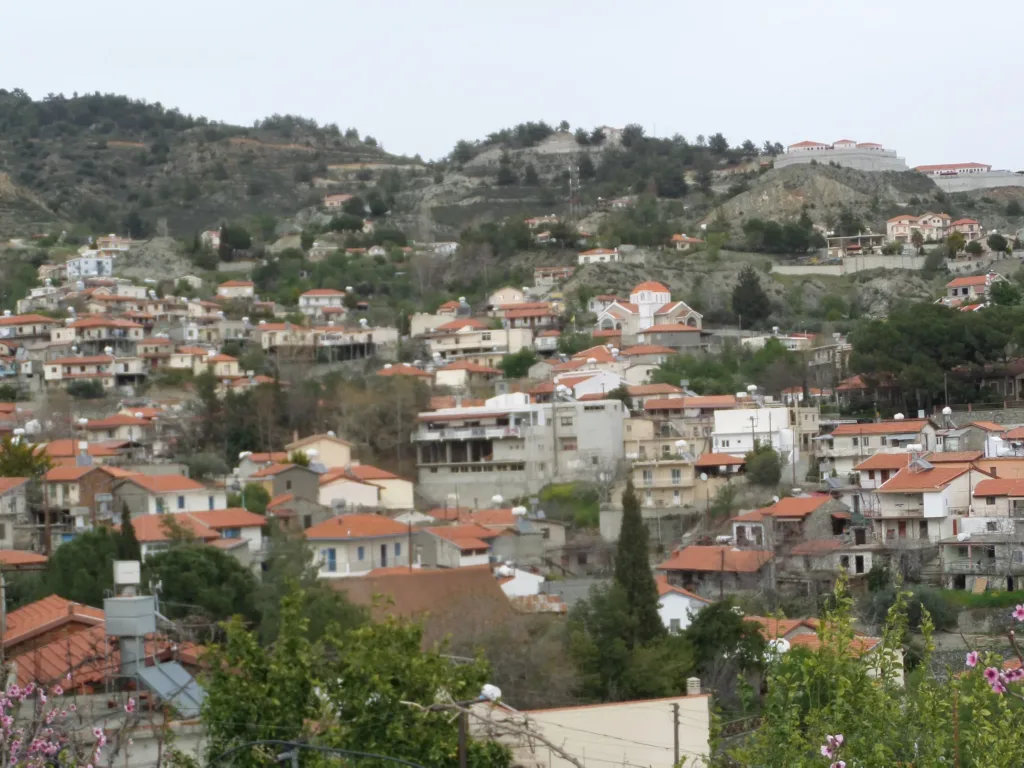
Pelendri, Cyprus: Holy Cross church, altitude and village guide
About the place
Checked: 25 October 2026.
Pelendri at a glance: a Pitsilia mountain village at 880 m
Pelendri (Greek: Πελένδρι) is a mountain village in the Limassol district, in the western part of the Pitsilia region on the slopes of the Troodos Mountains. According to the community council, Pelendri lies about 880 m above sea level, approximately 40 km from Limassol. At the 2021 census it had 1,026 residents. The village is known for the Church of the Holy Cross (Timios Stavros), which features 14th-century frescoes and is listed as a UNESCO World Heritage Site.
The village lies in the eastern part of the Karvouna–Saitta valley, surrounded by hills. Its neighbours are Kato Amiantos to the north-west, Potamitissa and Agros to the east, and Trimiklini to the west. Pelendri is also part of the Pitsilia Wine Route, one of Cyprus’s official wine routes.
The population has changed markedly over the past century and a half. According to the community council, 444 people lived here in 1881, 1,504 in 1946, and 2,253 in 1973. Numbers then fell: the 2001 census counted 1,350 people and the 2021 census 1,026.
History of Pelendri and theories about its name
Medieval documents refer to the village as Pelendres or Pelondres. The community council, citing the historian de Mas Latrie, writes that in 1353 Pelendri was a fief of John de Lusignan, a member of the Cypriot royal family; according to Visit Cyprus, he was the son of King Hugh IV. The council adds that in the Middle Ages Pelendri was also the administrative centre of the surrounding area.
The chronicler George Boustronios mentions Pelendri twice, including in connection with events of 1474 in the time of Queen Caterina Cornaro. The village’s main church is also linked to the Lusignan era: according to Visit Cyprus, the north aisle of the Holy Cross church served as the private chapel of the family of the Latin feudal lord John de Lusignan.
There are several theories about the origin of the name. It has been linked with the felandrio plant; with the poisonous pelendro mushroom (the historian N. Clerides argues the reverse, that the mushroom is named after the village); with an aromatic herb; with the medieval Pelendri family mentioned by the chronicler Leontios Machairas; and with the word ‘polydendri’, ‘many trees’. The community council lists all of these theories without choosing one.
What to see: the Holy Cross church and other churches
The Church of the Holy Cross (Timios Stavros) stands in the southern part of the village. According to Visit Cyprus, it was built around the middle of the 12th century as a single-nave church with a dome, and only the apse remains of that original church. An inscription in the apse dates the earliest frescoes to the 1170s: Visit Cyprus gives 1171/1172, while the community council gives 1178.
The church was later rebuilt and extended, and today it has three aisles and a dome. Its greatest treasure is the wall paintings of the second half of the 14th century in the Palaiologan style, the work of at least two painters. The church is part of the UNESCO property ‘Painted Churches in the Troodos Region’, which was inscribed on the World Heritage List in 1985.
There are other churches in the village. According to the community council, the 16th-century church of Panagia Katholiki is known for its icons of the same period and is protected by the Department of Antiquities. The parish church of Agios Ioannis Lampadistis stands out for its large dome, and Pelendri also has a church of the Archangel Michael.
Gardens, vineyards and local produce
Pelendri is a farming village. According to the community council, apples, pears, peaches and plums, olives, almonds and walnuts are grown here, as well as wine grapes and vegetables, including potatoes and tomatoes. The average annual rainfall in the village is around 750 mm.
The village lies on the Pitsilia Wine Route described by Visit Cyprus. The route runs from Limassol through Trimiklini, Pelendri, Potamitissa, Dymes, Kyperounta, Chandria, Polystypos, Alona, Agros, Agios Ioannis and Agios Theodoros. The vineyards of this zone lie around the peaks of Madari and Papoutsa and in the north-western part of the Machairas massif.
According to Visit Cyprus, Pelendri has two of the region’s well-known wineries, and the local grape varieties include the rare, ancient red Maratheftiko. Pelendri is also part of the Visit Cyprus ‘Cyprus Authentic Route 4’ driving itinerary, which is dedicated to wine. Visiting and tasting arrangements change, so book your visit in advance directly with the winery.
Nature and neighbouring Pitsilia villages
At around 880 m the climate is noticeably different from the coast: summers are generally cooler than in Limassol, and in winter you will need warm clothing. The Karvouna–Saitta valley and the surrounding hills are covered in orchards and vineyards, so the landscape changes considerably with the seasons.
Pelendri fits easily into a tour of Pitsilia. To the east lie Potamitissa and Agros, and further along the wine route come Dymes and Kyperounta, one of the highest villages in Pitsilia. To the north-west lies Kato Amiantos, closer to the central part of the Troodos Mountains.
For walking, choose the official nature trails in the Pitsilia and Troodos areas: their descriptions, lengths and difficulty levels are published by the Department of Forests and Visit Cyprus. Before heading into the mountains, check the weather forecast and the condition of the trails, especially in winter and after heavy rain.
Getting to Pelendri and planning your visit
Pelendri is about 40 km from Limassol, and on the Pitsilia Wine Route the road from Limassol goes through Trimiklini. The easiest way to get there is by car. The mountain roads here are winding, so allow more time for the journey than the distance alone would suggest.
If you want to travel by public transport, check with the Limassol district bus operator whether any services currently run to Pelendri and how often. Rural routes run less often than urban ones, so find out the time of the return bus in advance.
For an unhurried visit, allow half a day: see the Holy Cross church, walk around the village and, if there is time, drive on to neighbouring Potamitissa or Agros. If you plan to visit a winery, arrange your visit in advance and decide who in your group will be the designated driver.
What to check before visiting Pelendri
The opening hours of the Church of the Holy Cross vary depending on the season, and according to Visit Cyprus, it is closed on public holidays. Check the church’s page on the Visit Cyprus website for current hours and contact details shortly before your trip: it warns that opening times may change without notice.
The 14th-century frescoes are fragile. Keep quiet inside, do not touch the walls or icons, and ask the custodian before taking photographs; flash photography is usually prohibited in painted churches. Clothing must cover the shoulders and knees.
The other churches in the village are not always open. To see inside Panagia Katholiki or the church of the Archangel Michael, ask the Pelendri community council or the local priest whether a visit is possible. In winter, check the condition of the mountain roads before setting off.
Continue planning
Official sources
- 2021 Population Census — Cyprus Statistical Service (CYSTAT)
- Village history — Pelendri Community Council website
- Timios Stavros (Holy Cross) Church in Pelendri — Visit Cyprus
- Painted Churches in the Troodos Region — UNESCO World Heritage Centre
View of Pelendri · Photo: Xaris333 · CC BY-SA 4.0 · converted to WebP and resized.
