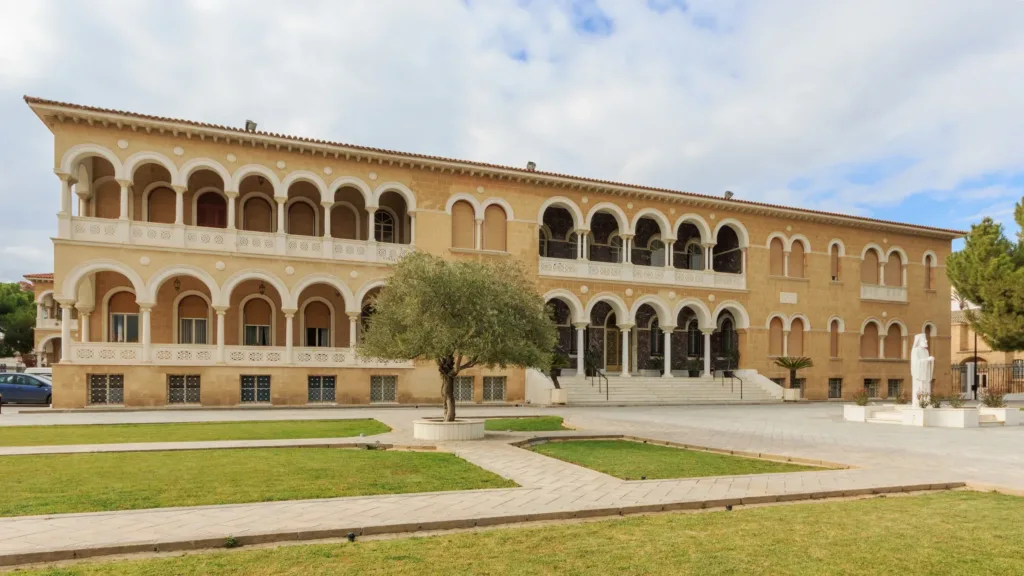
Archbishop’s Palace, Nicosia: history, cathedral and Byzantine Museum
About the place
Checked: 25 October 2026.
Archbishop’s Palace in Nicosia: what it is and where
The Archbishop’s Palace (Αρχιεπισκοπικό Μέγαρο, Archiepiskopiko Megaro) is the residence and offices of the Archbishop of Cyprus, head of the Church of Cyprus, in the old town of Nicosia. The complex stands on Archbishop Kyprianos Square (Πλατεία Αρχιεπισκόπου Κυπριανού). According to the Nicosia Municipality, the new palace houses the offices of the Archbishopric, the Archbishop’s residence, the Byzantine Museum and the Library of the Archbishopric.
Several different sites share the same grounds: the new palace from the mid-20th century, the old palace from the 18th century, St John’s Cathedral (St John the Theologian) and the Cultural Centre of the Archbishop Makarios III Foundation with the Byzantine Museum. So a search for ‘Archbishop’s Palace’ usually means this whole quarter rather than a single building.
The new palace is a working residence, not a museum. Visitors usually come for the Byzantine Museum, the cathedral and the museums in the old palace, and see the palace itself from outside. Check with the Archbishop Makarios III Foundation and the Archbishopric what exactly is open inside on the day of your visit.
History of the old and new palaces
The old Archbishop’s Palace is an 18th-century two-storey building that the Nicosia Municipality calls a religious, national and political monument. Visit Cyprus dates it to 1730. After the new building was put up, museums were housed in the old palace.
The new palace was built by Archbishop Makarios III between 1956 and 1960 in the Neo-Byzantine style; Visit Cyprus gives the date as 1960. It is a two-storey stone building which, according to Visit Cyprus, also houses the private quarters of the late Archbishop Makarios III. Descriptions of the palace as ‘Venetian’ are not corroborated by official sources.
According to the Cyprus Ministry of Education, during the coup of 15 July 1974 the Archbishopric was one of the places where there was resistance, along with the Presidential Palace and the area around police headquarters. The large bronze statue of Makarios III that used to stand in front of the palace was later moved to Throni, next to his grave near Kykkos Monastery.
St John’s Cathedral
St John’s Cathedral (Άγιος Ιωάννης, Agios Ioannis) stands next to the Archbishopric. According to Visit Cyprus, it was built on the site of a 14th-century chapel of a Benedictine abbey. In 1662 Archbishop Nikiforos rebuilt the monastery church from the ground up.
The church remained a monastery church until the 18th century, when Archbishop Sylvester made it the cathedral and seat of the Orthodox Archbishop of Cyprus. Inside, 18th-century wall paintings survive with scenes from the Bible and the discovery of the tomb of the Apostle Barnabas. According to Visit Cyprus, it is the only church in Nicosia whose interior frescoes have survived in full.
The four large icons of the iconostasis were painted by the Cretan master Ioannis Kornaros in 1795 and 1797. The cathedral is a working church, so tourists are let in at set times, and during services it is important not to disturb worshippers. According to Visit Cyprus, visiting hours may change without notice.
The Byzantine Museum and the old palace museums
The Byzantine Museum of the Archbishop Makarios III Foundation is in the Foundation’s Cultural Centre on the grounds of the Archbishopric, in the courtyard of the old St John’s Cathedral. According to the Visit Cyprus audio guide, in 1972 Makarios III decided to build the museum next to the Archbishop’s Palace. After the events of 1974 the project was delayed, and the museum opened in 1982.
After almost five years of renovation, the museum reopened on 18 March 2025. According to the Foundation, the display is now arranged chronologically, covers the period from the 4th to the 18th century and has been extended with digital galleries. The Visit Cyprus audio guide to the museum names among the highlights the fragments of the 6th-century mosaic from the church of Panagia Kanakaria that were returned to Cyprus; check with the museum what the new display includes.
Besides the museum, the Foundation’s Cultural Centre includes an art gallery and a library. According to the Nicosia Municipality, the old palace houses the Folk Art Museum and the National Struggle Museum, while Visit Cyprus calls the museum on the lower floor the Ethnographic Museum of Cyprus. Our separate overview of Nicosia museums tells you more about the capital’s museums.
Getting there and planning your visit
The Archbishopric is in the old town of Nicosia, inside the Venetian walls. It is easy to walk here through the narrow streets of the old town, so it is best to leave the car in one of the car parks at the edge of the old town. For the sat-nav, use Archbishop Kyprianos Square.
Each site keeps its own hours. Since the renovation the Byzantine Museum has a new schedule, the cathedral has a separate one, and the museums in the old palace keep their own hours. So one visit to the quarter can take in the museum, the cathedral and a walk around the palace, but check the hours of each site separately.
Church etiquette applies in the cathedral and on the grounds of the Archbishopric. Wear clothes that cover your shoulders and knees, speak quietly and put your phone on silent. Take photographs inside the cathedral and the museums only where this is allowed; the residence’s working premises are not meant for tourists.
What is nearby
The Archbishopric quarter is part of old Nicosia inside the walls, with other churches, museums and shopping streets close by. For a general route around the city and its districts, see our Nicosia guide.
If you want to build a day around museums, our overview of Nicosia museums will help you choose what to see after the Byzantine Museum. We do not repeat it here and only note that the Archbishopric makes a convenient stop on such a route.
Nicosia is hot in summer, so plan your walk around the old town for the morning or evening and spend the middle of the day in museums. Take water and comfortable shoes for the narrow streets.
What to check before you go
Check the Archbishop Makarios III Foundation website for the current opening days and hours of the Byzantine Museum and the art gallery, and for ticket prices. Since the 2025 renovation, old schedules and prices no longer apply.
Check the visiting hours of St John’s Cathedral on the Visit Cyprus website or with the Archbishopric, especially on holidays and during major church services. Check the opening hours of the museums in the old palace with the museums themselves.
If wheelchair access matters to you or you are coming with a group, contact the Foundation in advance and ask about the visiting arrangements. It is also best to check the rules on photography and filming in the museum and the cathedral before your visit.
Continue planning
- Nicosia: Cyprus capital in the centre of the island
- Museums in Nicosia: what to choose and how to plan your visit
- Monasteries in Cyprus
Official sources
- Nicosia Municipality: Archbishop's Palace
- Archbishop Makarios III Foundation: Byzantine Museum
- Visit Cyprus: Agios Ioannis (St John's) Cathedral
- Visit Cyprus: Archbishop's Palace
The Archbishop's Palace in Nicosia · Photo: A.Savin · FAL · converted to WebP and resized.
