Monasteries in Cyprus: Guide by Region and Visiting Rules
About the place
Checked: 25 October 2026.
Monasteries of Cyprus at a glance
The monasteries of Cyprus (Μοναστήρια της Κύπρου, Monastiria tis Kyprou) are working Orthodox religious houses of the Church of Cyprus, from the mountain monasteries of Troodos to small monasteries near the coast. Above all they are places of prayer and monastic life, not museums: visitors are received, but on the terms that each monastery sets.
The rules differ noticeably. Women are not admitted to Stavrovouni Monastery, photography and filming are not allowed at Machairas, and Trooditissa Monastery, according to the Cyprus Tourism Organisation, is closed to visits as a place of secluded prayer, with only its church open.
Below, the monasteries are grouped by region, with one or two practical facts for each. Our site has detailed guides to the Kykkos, Agios Neophytos, Sfalangiotissa, Agios Georgios Mavrovouniou and Ayia Napa monasteries, and the monastery of Agios Georgios Alamanos is described in our guide to the village of Pentakomo.
Monastic life and what it means for visitors
A monastery is home to a community of monks or nuns, and the day there revolves around services and work. Visit Cyprus gives a telling figure for one district: of the 12 surviving monasteries in the Limassol district, 9 are inhabited by monks or nuns. The rest currently have no permanent community.
For visitors, this means fitting the visit around the life of the community. The Tourism Organisation notes that many monasteries do not receive group tours on Saturdays and Sundays, and at religious houses such as Machairas and Agios Irakleidios guides should give their talk outside the gates so as not to disturb the monastic community.
Many monasteries run their own estates. Kykkos Monastery, according to Visit Cyprus, produces zivania and other drinks, Chrysorrogiatissa Monastery has an old winery that you can visit, and the monks of Agia Varvara Monastery at the foot of Stavrovouni are known as icon painters.
Troodos and the Nicosia district
Kykkos Monastery stands on a mountain peak at an altitude of 1,318 metres in the Marathasa Valley in Troodos, in the Nicosia district. According to Visit Cyprus, the Byzantine Emperor Alexios Komnenos sent the funds for its construction, as well as the icon of the Virgin Mary that tradition attributes to the Apostle Luke. The monastery has a museum, and church feasts are held here on 15 August and 8 September.
Machairas Monastery stands on the slopes of Mount Kionia in the Machairas mountains, also in the Nicosia district. By tradition, a hermit hid the icon of the Virgin Mary in a cave during Iconoclasm, and around 1145 the hermits Ignatios and Neophytos found the cave. Photography and filming are not allowed in the monastery.
Some monasteries in the Troodos mountains are harder to get into: at Trooditissa Monastery only the church is open to visitors. The monastery churches of St John Lampadistis in Kalopanayiotis and Panagia tou Araka in Lagoudera are on the UNESCO World Heritage List, and the Agios Irakleidios Convent stands in the village of Politiko near the Royal Tombs.
Larnaca and Limassol
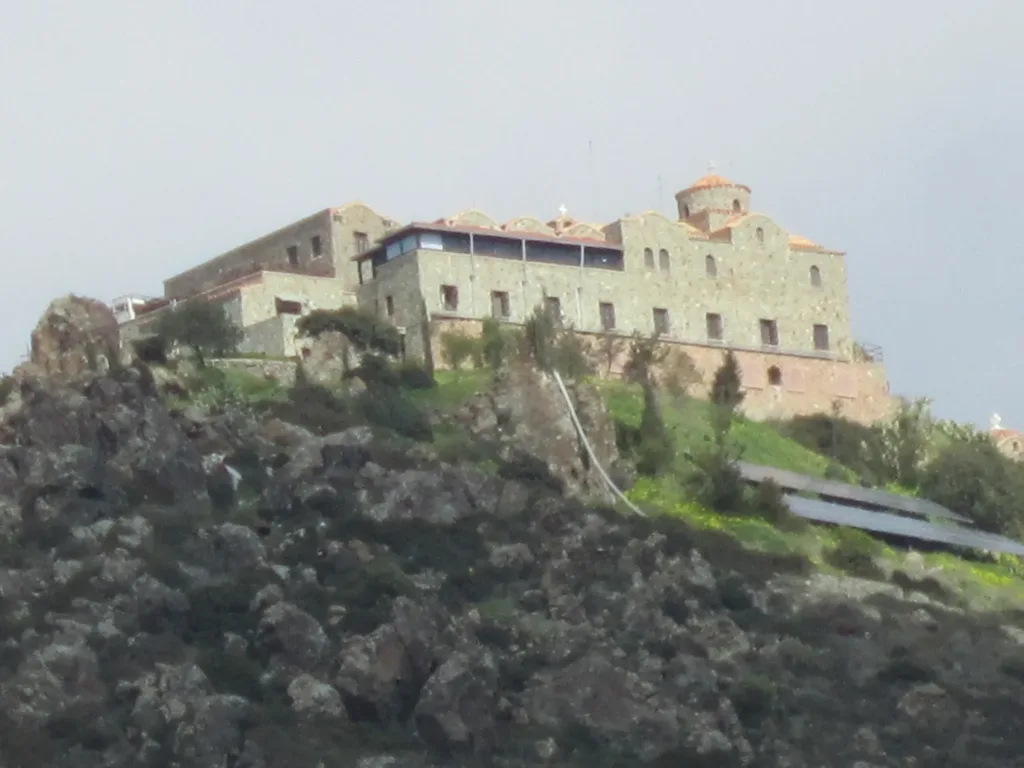
Stavrovouni Monastery stands on a rocky peak at an altitude of 750 metres in the Larnaca district. By tradition, it was founded in the 4th century by St Helena, who left a piece of the Holy Cross here. Women may not enter the monastery, photography and filming are also banned, and men must be suitably dressed. Agia Varvara Monastery at the foot of the mountain is open to all visitors.
The Agios Minas Convent is near the village of Lefkara in the Larnaca district. Also in the Larnaca district, near the village of Troulloi, stands the Agios Georgios Mavrovouniou Monastery, which has its own guide. In the Limassol district, on Cape Gata near Akrotiri, stands the Monastery of St Nicholas of the Cats: by tradition, cats were brought here to rid the cape of snakes, and cats still live at the monastery today. According to Visit Cyprus, nuns revived the monastery in 1983.
In the village of Omodos is the Holy Cross Monastery (Timios Stavros), which, according to Visit Cyprus, keeps a piece of the rope with which Christ was tied to the cross and has preserved carved wooden ceilings. Also in the Limassol district are the monasteries of Panagia Sfalangiotissa in Agios Athanasios, which has its own guide, and Agios Georgios Alamanos near the village of Pentakomo, covered in our guide to that village.
Paphos and the east of the island
Agios Neophytos Monastery lies north of Paphos, near the village of Tala. According to the Department of Antiquities, the hermit and writer Neophytos settled in a rock-cut cell, the Enkleistra, in 1159. The Enkleistra is painted with Byzantine frescoes, and the monastery has an ecclesiastical museum; there is more about it in a separate guide.
Chrysorrogiatissa Monastery (Panagia Chrysorrogiatissa) stands near the village of Panagia in the Paphos district. According to the tradition cited by Visit Cyprus, it was founded in 1152 by the monk Ignatios, who found a miraculous icon of the Virgin Mary off the shore of Paphos. The monastery has a treasury of icons and church plate, and wine is made in the old monastery winery.
In the east of the island, the main monastery is Ayia Napa Monastery in the centre of the resort of the same name, built under the Venetians and since 2007 under the Holy Metropolis of Constantia and Ammochostos. It has its own guide on our site.
What to wear and how to behave
The Cyprus Tourism Organisation asks visitors not to come to monasteries and churches in shorts, backless tops or very short dresses, and not to dress too much as if for the beach. Covered shoulders and knees are the safe choice for everyone. If you are going to a monastery after the beach, take a shirt, a scarf or a long skirt with you.
Ask permission before taking photographs. Flash is not allowed: according to the Tourism Organisation, it can damage icons and frescoes, and at Stavrovouni and Machairas photography is banned altogether. During a service, speak quietly, put your mobile on silent, do not photograph worshippers and do not go into the sanctuary.
Restrictions for women or men apply only at certain monasteries. The best-known example is Stavrovouni, which does not admit women; if you are travelling as a mixed group, the women can visit Agia Varvara Monastery at the foot of the mountain. Many small monastery churches are locked, and the Tourism Organisation advises asking the priest or the person in charge in the village.
What to check before you go
Visiting hours. Many monasteries keep different summer and winter hours, some close for a break in the middle of the day, and Visit Cyprus lists Stavrovouni and Kykkos as closed on public holidays. Before you go, check the times with the monastery itself or with the Holy Metropolis it belongs to.
Groups and feast days. If you are travelling as a group, arrange the visit in advance: some monasteries set aside particular days and hours for groups. On major feast days, such as 15 August and 8 September at Kykkos, it gets very crowded, and monastery museums keep their own hours.
Special rules. Before your visit, check whether the monastery you have chosen admits women or men, whether photography is allowed and whether it is open to tourists. The surest way to find out is to ask the monastery itself, the Church of Cyprus or a Visit Cyprus information office.
Continue planning
- Kykkos Monastery: history, museum and a visit
- St Neophytos Monastery: frescoes and a visit
- The Monastery of the Most Holy Mother of God, Sfalangiotissa
Official sources
- Visit Cyprus: Stavrovouni Monastery and visitor rules
- Visit Cyprus: Kykkos Monastery
- Visit Cyprus: Machairas Monastery
- Cyprus Tourism Organisation: Travellers Handbook, monasteries and visiting notes
Stavrovouni Monastery on its mountain top · Photo: Dickelbers · CC BY-SA 3.0 · converted to WebP and resized.
