Galata village, Cyprus: Panagia Podithou and Solea’s painted churches
About the place
Checked: 29 October 2026.
Galata at a glance: a village of balconies and painted churches in the Solea valley
Galata (Greek: Γαλάτα) is a mountain village in the Nicosia district, in the Solea valley (Σολέα) on the northern slopes of the Troodos. According to the community council, it lies about 60 km west of Nicosia. The village stands at 620 m above sea level, on both banks of the Klarios river, also known as the Karkotis (Καρκώτης).
According to the 2021 census, the village has 571 residents. Galata runs straight into neighbouring Kakopetria: the community council calls the two villages the twin sisters of Solea. Kakopetria has its own page on our site.
The main sight is the church of Panagia Podithou, Galata’s only monument on the UNESCO World Heritage List. Visit Cyprus, the official portal of the Deputy Ministry of Tourism, counts four painted churches in the village, while the community council counts six Byzantine churches. Galata is also known for its wooden balconies and its fruit: apples, apricots, peaches and cherries.
History and origin of the name
The community council gives two explanations of the name. According to the first, shepherds lived west of the village, at a place called Esso Galata, and people from the villages lower down went to them for milk: ‘gala’ is Greek for milk. According to the second, the first settlers came from Galatia in Asia Minor as early as Byzantine times.
Galata is mentioned by the medieval chronicler Leontios Machairas, who cites the account of a certain Maria who looked after the falcons of Sir Henry de Giblet in Galata. From this the council concludes that under Frankish rule the village belonged to the de Giblet family. Medieval maps, including that of Giacomo Franco, mark it as Galata or Golata.
In 1735 the Russian traveller Vasily Grigorovich-Barsky, who was touring the monasteries of Cyprus, stayed the night in Galata. The community council quotes his description of it as a village ‘the most beautiful of all’, with many fruit trees and plenty of running water.
Panagia Podithou: the UNESCO-listed church
The World Heritage Site ‘Painted Churches in the Troodos Region’ comprises ten churches, and Galata’s entry is the church of Panagia Podithou. The site was inscribed in 1985. UNESCO describes the Podithou paintings as one of the best examples of the Italo-Byzantine school, in which the Byzantine tradition merged with the art of the Italian Renaissance.
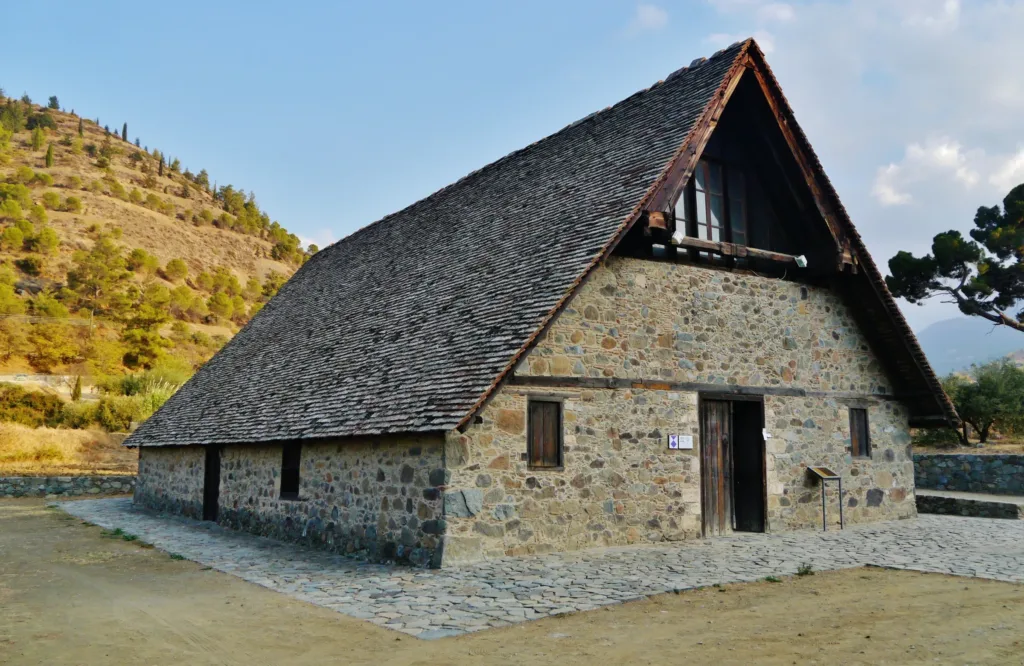
The church stands at the northern entrance to the village, on the right of the road from Nicosia. According to the inscription over the west door, it was built in 1502 at the expense of Dimitrios de Coron and his wife Helena; Visit Cyprus says Dimitrios was captain of the barony of Pentagia. The church is dedicated to the Virgin Eleousa (the Merciful) and was the main church of a small monastery that no longer exists.
The paintings cover only part of the walls: the apse, with the Virgin enthroned between archangels, the gables and the outer west wall. The community council links the name Podithou to the painting of Moses taking off his sandals before the Burning Bush, and to the Greek ‘apodithou’, ‘take off your shoes’. The council considers the gilded carved iconostasis one of the finest iconostases of the 16th century. Its royal doors were stolen in early 2003.
Other churches in Galata
Next to Podithou stands the small church of Archangel Michael, also known as Panagia Theotokos. Visit Cyprus dates its paintings to the early 16th century. According to Visit Solea, the regional tourism portal of the Solea valley, the frescoes are the work of the painter Symeon Axenti, and an inscription dates them to 1514.
The church of Agios Sozomenos stands in the centre of the old village. Visit Cyprus reports that, according to the inscription over the west door, it was built and painted in 1513. The cost of the paintings was met by 14 villagers. The outer north wall shows the Last Judgement, the Tree of Jesse and the Ecumenical Councils.
The small church of Agia Paraskevi stands by the road from Galata to Kakopetria; its frescoes survive mainly in the apse and on the gable. In the centre, above the main street, stands the church of Panagia Odigitria, around which the old settlement grew up. Visit Solea also lists the chapels of St George and St Nicholas among Galata’s old churches.
Balconies, the museum and the Klarios river
The community council calls Galata the ‘village of balconies’. Along the main street towards Kakopetria stand two-storey houses with wooden balconies, built around 1900; according to the council, they are protected by the Department of Antiquities. The oldest balconies begin opposite the chapel of St George and run as far as the former inn, Chani tou Marangou.
In 1990 a village folk art museum opened in this restored inn. It later moved to the old primary school building. According to the council, the collection holds more than 500 items arranged by craft: tools of shepherds, farmers, silk farmers, potters and shoemakers, as well as clothing and kitchenware.
According to Visit Solea, the Klarios is one of the few rivers in Cyprus that flow all year round, and its valley is part of the Natura 2000 network. A trail follows the river from the church of Archangel Michael to the old Rodou mill. According to the Department of Forests, it is 1 km long and in the easiest difficulty category.
How to get to Galata and plan your visit
The easiest way to get there is by car along the main Nicosia–Troodos road, which brings you into the village past Panagia Podithou. Visit Solea puts the Solea valley about 56 km from Nicosia and roughly the same distance from Limassol via Kato Amiantos.
Without a car, check in advance with the Nicosia district bus operator whether there is a service to Solea on the day you need and when the return bus leaves. In Galata, Podithou and the church of Archangel Michael stand side by side at the village entrance, and Agios Sozomenos is in the old centre; you can walk between them.
Panagia Podithou, the church of Archangel Michael, the mill trail and the old centre usually take half a day. The trip is easy to continue to Kakopetria, which also has a painted church on the UNESCO list.
What to check before visiting Galata
According to Visit Cyprus (page updated in 2025), Panagia Podithou is open Tuesday to Sunday on a seasonal timetable, is closed on public holidays, and admission is free. Visit Cyprus lists the other churches as open by arrangement. Opening times may change, so call the caretaker on the phone number given on the church’s page.
According to the community council, the folk art museum is open on weekdays, and at weekends and on public holidays it opens by arrangement with the council. The usual church etiquette applies: covered shoulders and knees and quiet voices; ask the caretaker before photographing the paintings.
The community council publishes its events programme on its website: summer evenings, a festival of traditions and local food in early September, and Easter and Christmas gatherings. The dates change every year.
Continue planning
- Kakopetria: the old quarter, how to get there and a stroll
- Troodos: villages, trails and routes through the mountains of Cyprus
- Hiking routes and nature trails in Cyprus
Official sources
- Statistical Service of Cyprus: Census of Population 2021, population by community
- UNESCO: Painted Churches in the Troodos Region
- Visit Cyprus: Panagia Podithou Church
- Visit Cyprus: Agios Sozomenos Church
- Galata Community Council: history
- Cyprus Department of Forests: nature trails outside state forests
The church of Panagia Podithou in Galata · Photo: Zairon · CC BY-SA 4.0 · converted to WebP and resized.
