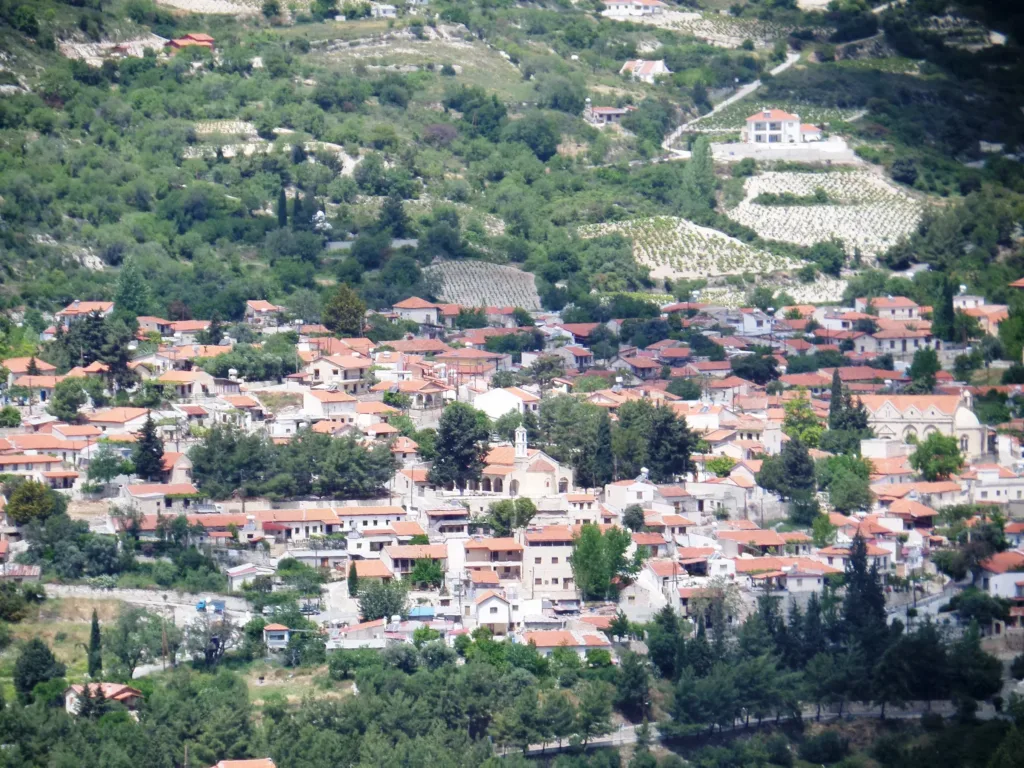
Koilani (Kilani), Cyprus: wine village and Agia Mavri chapel
About the place
Checked: 25 October 2026.
Koilani at a glance: where it is and what it is known for
Koilani (Greek: Κοιλάνι) is a winemaking village in the Limassol district, in the Krasochoria (‘wine villages’) area on the slopes of the Troodos Mountains. According to Visit Cyprus, it lies 820 m above sea level, about 35 km from Limassol; at the 2021 census it had 177 residents. The village is known for its wine, its grape sweets and the chapel of Agia Mavri (St Mavra) beneath a huge plane tree.
In English the name is written both Koilani and Kilani. Do not confuse it with neighbouring Vasa Koilaniou, a separate community with its own entry on Visit Cyprus.
Visit Cyprus calls Koilani one of the island’s main grape-growing centres. The village has kept its traditional architecture: houses with picturesque lofts, arches and decorated frames. For visitors it combines vineyards, small museums and an old chapel by the river.
History of Koilani and its name
Visit Cyprus gives three theories about the origin of the name. According to the first, in antiquity the village was called Kourion, after a son of the mythical Cypriot king Kinyras; the name survived until the Byzantine period, and under the Franks the village was renamed Koilani. According to the second, the first inhabitants came from ancient Kyllene in the Peloponnese.
The third theory links the name to the village’s location in a valley; in Greek, ‘valley’ is κοιλάδα. All three explanations are traditions and hypotheses; none is confirmed by documents.
The oldest monument in the area is the chapel of Agia Mavri (St Mavra). An academic article published in the Deltion of the Christian Archaeological Society dates the first building phase of the church to the 11th–12th centuries; in the 15th century the church was renovated, and most of its frescoes date from the second half of the 15th century. The church has been a centre of the veneration of St Mavra since Byzantine times. According to local legend, Mavra was a girl from Koilani who hid with her beloved, Timothy, in a cave where the chapel now stands, and then opened a passage through the rock to Pera Pedi; later, tradition says, both were martyred.
What to see in Koilani
The chapel of Agia Mavri stands outside the village, between Koilani and Pera Pedi, on the bank of the Kryos, the ‘Cold River’. It is shaded by a huge plane tree: according to All About Limassol, the tree is about 800 years old, about 38 m tall and about 8 m round at the base, and it is protected.
Old frescoes survive inside the chapel, and at the far end water regarded as holy flows from an opening in the rock. A few dozen metres away is the old stone bridge of Agia Mavri, attributed to the Venetian period. The riverbanks can be slippery, so take care by the water.
In the village itself, Visit Cyprus highlights the church of Monogenis (Christ the Only-Begotten), the Viticulture Museum and the Ecclesiastical Museum, an old olive press and wineries. The museums are small, so check their opening hours with the community office in advance.
Wine, grape sweets and festivals
Grapes shape life in Koilani. Wine and grape products are made here, and according to Visit Cyprus, some houses still contain equipment for distilling zivania – a strong Cypriot spirit made from grape pomace. Several wineries operate in and around the village; check visiting arrangements with them directly.
Among local baked goods, Visit Cyprus mentions arkatena, crunchy yeast rusks. The wine villages of this part of the Limassol district also make sweets from grape must: soutzoukos and palouzes.
According to Visit Cyprus, the village holds an annual autumn grape festival; the exact day has to be checked each year. Visitors can watch residents make traditional grape-juice sweets, try them, listen to folk music and taste wine. A 1998 archive publication also mentions an ‘Afamia’ festival devoted to wine, grapes, raisins and palouzes.
Walks, nature and the surrounding area
Around Koilani are hillside vineyards and the Kryos valley. The road from the village to the Agia Mavri chapel runs through open countryside; if you walk part of the way, keep to a safe verge and allow for the summer heat.
Koilani is on the Visit Cyprus circular driving route ‘Celebrating the Vine’ through the wine villages of the Limassol district. The route runs from Agios Amvrosios through Vouni and Koilani to Pera Pedi, and the Agia Mavri chapel stands just past Koilani on the road to Pera Pedi.
Other Krasochoria villages are close by: Vouni, Pera Pedi and Vasa Koilaniou, as well as Omodos, which has its own guide on our site. They can easily be combined in one day by car, but the roads here are winding, and Visit Cyprus advises you to take extra care on bends.
Getting to Koilani and planning your visit
Koilani is about 35 km from Limassol. You can approach from the Limassol–Troodos road via Pera Pedi, or from the Omodos and Vouni side. Check the exact route in your navigation app by entering Koilani or Κοιλάνι.
Half a day is enough for the village, the Agia Mavri chapel and one of the museums; if you add wineries and neighbouring villages, allow a full day. Decide in advance who will be driving after the wine tastings.
The busiest time of year is the grape harvest and the autumn festivals. Spring and late autumn are cooler and quieter, and in summer morning or evening is best for walking. Public transport to the wine villages is limited, so most people come by car or on an organised tour.
What to check before visiting Koilani
Check whether the Viticulture Museum, the Ecclesiastical Museum and the Agia Mavri chapel are open on the day you plan to go: hours in small villages change, and some sites open by arrangement. Ask at the Koilani community office or at Visit Cyprus information centres.
Check the dates of the grape festival and other events closer to your trip in the Visit Cyprus calendar and in community announcements. If you want to visit a winery, ask the winery itself in advance whether it receives visitors and whether booking is required.
The Agia Mavri chapel is a place of worship, not just a sight. Wear clothing that covers your shoulders and knees, do not touch the frescoes or icons, do not use flash and do not make noise by the spring. Look after the protected plane tree: do not climb on the roots, do not light fires nearby and do not leave litter behind.
Continue planning
Official sources
- CYSTAT — Census of Population and Housing 2021: population by place of residence
- Visit Cyprus — official Koilani village page
- All About Limassol — Agia Mavri church, Koilani
- Visit Cyprus — Cyprus Authentic Route 4 brochure, Celebrating the Vine
Koilani and the terraced hillsides · Photo: Xaris333 · CC BY-SA 4.0 · converted to WebP and resized.
