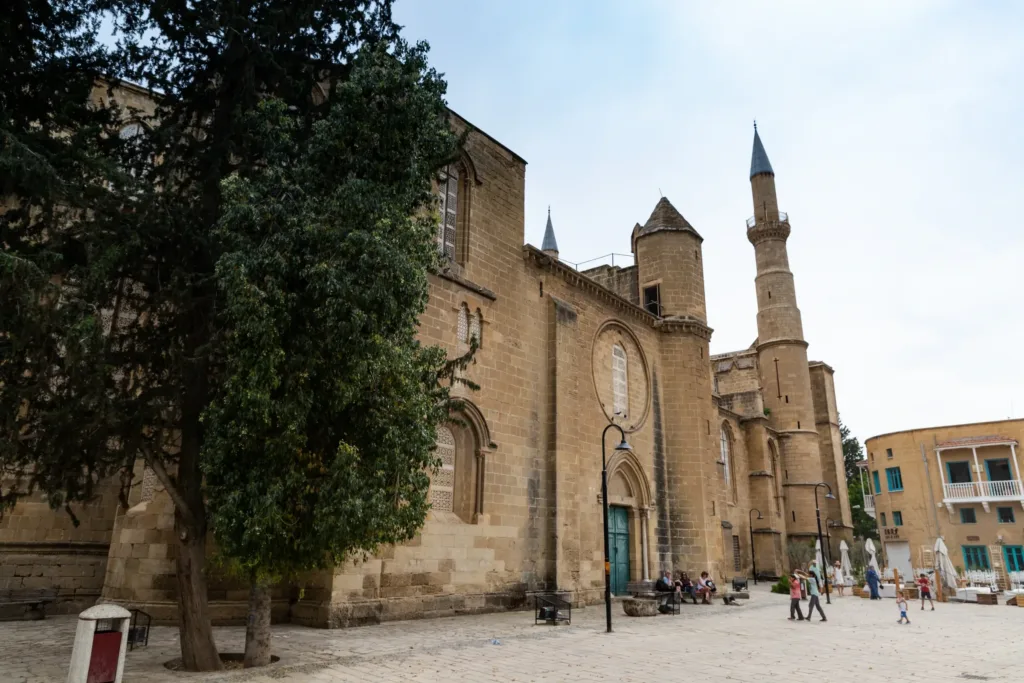
Agia Sofia Cathedral (Selimiye Mosque), Nicosia: History and Visit
About the place
Checked: 25 October 2026.
St Sophia Cathedral in Nicosia: in brief
St Sophia Cathedral (Agia Sofia) is the Latin cathedral in the old town of Nicosia, which is surrounded by Venetian walls. It stands in the northern part of the capital, which has been under Turkish occupation since 1974. Since 1570, the building has served as a mosque, and in 1954 it was given the name Selimiye.
According to the Department of Antiquities of the Republic of Cyprus, this is the largest and oldest of Cyprus’s surviving Gothic churches: its interior measures 66 by 21 metres. The cathedral may have been built on the site of an earlier Byzantine church.
Visitors from the south usually walk here through the Ledra Street crossing point. Below, you can read about how the cathedral was built, what changed after 1570, and how to behave in a functioning mosque.
How the Gothic cathedral was built
Construction began in the early years of Frankish rule — according to the Department of Antiquities, possibly in 1209. By 1228, the eastern section was complete, and by the end of the 13th century, the side aisles and most of the central nave were finished.
Between 1319 and 1326, the Latin Archbishop Giovanni del Conte completed the central nave, the buttresses and the façade, added a chapel to the south wall which served as a baptistery, and adorned the cathedral with frescoes and sculptures. The official consecration took place in November 1326.
Due to the scale of the building, a lack of funds and historical events, construction of the cathedral took around 150 years, and it was never fully completed. According to the Department of Antiquities, the south-western tower and the upper tier of the portico were never built. Inside it is a three-aisled Gothic basilica with pointed vaults, so even after its conversion into a mosque the interior recalls French cathedrals of the same period.
The façade and the bull of 1347
Even after the consecration, work continued. In 1347, the Pope issued a bull ordering the completion and restoration of the cathedral, which had been damaged by an earthquake, and it was at that time that the portico and the north-west tower were built.
The main feature is the western wall with its three entrances. According to the Department of Antiquities’ description, the frame of the main portal is covered with elaborate carvings: three of the four arches depict kings, prophets, apostles and bishops.
The cathedral is one of the most famous Gothic monuments from the Frankish period in Cyprus, which lasted from 1192 to 1489. In the Deputy Ministry of Tourism’s history brochure, it is mentioned alongside St Nicholas’ Cathedral in Famagusta and Bellapais Abbey.
The cathedral of the Lusignan kingdom
Under the Lusignans, the Catholic Church was the official state church, and Saint Sophia was the principal Latin cathedral in Nicosia. According to historical accounts, the kings of Cyprus from this dynasty were crowned here, whilst they were crowned as kings of Jerusalem at St Nicholas’s Cathedral in Famagusta.
Kings and members of the nobility were buried in the cathedral. According to the Department of Antiquities, the tombs of several kings and princes of the Lusignan dynasty were destroyed following the Ottoman conquest, which is why there are now almost no medieval monuments left inside the cathedral.
As well as earthquakes, the cathedral suffered damage during wars: in 1373, Nicosia was sacked by the Genoese, who had captured Famagusta. The Venetians, who ruled the island after the Lusignans, repaired the building, but by that time its Gothic appearance had already been fully established.
A mosque since 1570
In 1570, Nicosia was captured by the Ottomans, and St Sophia was converted into a mosque. Two minarets were added to the western part of the building, and they still define the skyline of the old town.
At the same time, according to the Department of Antiquities, the rich sculptural decoration, frescoes, sculptures and stained-glass windows depicting scenes from the Old and New Testaments were destroyed. The interior was adapted for Muslim prayer, whilst the Gothic architecture of the walls and vaults has been preserved.
For a long time the building was known as the Ayasofya (Agia Sofia) Mosque. In August 1954, it was renamed the Selimiye Mosque in honour of Sultan Selim II, who reigned from 1566 to 1574, when the Ottomans conquered Cyprus.
Restoration and current condition
The building remains an active mosque. In May 2025, as reported by the Cyprus Mail, the mosque reopened following restoration work that lasted around five years.
The Department of Antiquities of the Republic of Cyprus includes the cathedral on its list of the most important monuments in the occupied part of the island and describes it as the Latin Cathedral of Saint Sophia. Consequently, in Greek and official sources it is usually called Agia Sofia, while Turkish sources call it Selimiye.
Nearby stand other monuments of old Nicosia. According to the Department of Antiquities, to the south of the cathedral lies the Church of Panagia Odigitria, known as the Bedestan: during the Ottoman period, it housed a covered textile market. To the east of the cathedral stands the Sultan’s Library, dating from 1829, whilst to the west lies the Büyük Han caravanserai, probably built in 1572. It is convenient to visit them all in a single walk.
How to visit
From the south, the easiest way to reach the cathedral is on foot through the Ledra Street crossing point; the Ledra Palace crossing is also for pedestrians. The cathedral’s minarets are visible from many streets in the old town, so they serve as a useful landmark. Documents are checked at the crossing point, and the rules for crossing – including those for foreign nationals – are explained in our article on the Green Line.
The cathedral is an active mosque, so access may be restricted during prayer times. General mosque etiquette applies: shoulders and knees must be covered; women must wear a headscarf; shoes must be removed at the entrance; visitors must speak quietly inside; and photographs of worshippers must not be taken.
Check opening hours and visiting conditions on site: the Republic’s official sources do not publish this information. Photography is prohibited near military installations and checkpoints in the north, and goods brought from the north are subject to customs checks upon returning to the south.
Continue planning
- Cyprus Green Line: crossings and travel to the north
- Nicosia: Cyprus capital in the centre of the island
- Northern Cyprus: Status, Crossing the Line and What to Check
Official sources
- Department of Antiquities of the Republic of Cyprus: St Sophia Cathedral, Nicosia
- Department of Antiquities: important monuments in the occupied area
- Deputy Ministry of Tourism: Cyprus, 10,000 years of history and civilisation
- Cyprus Mail: Selimiye Mosque reopens after restoration (May 2025)
The former St Sophia Cathedral (Selimiye Mosque) in Nicosia · Photo: dronepicr · CC BY 2.0 · converted to WebP and resized.
