Kyrenia: the harbour, the old town and planning a visit
About the place
Checked: 25 October 2026.
Kyrenia: in brief
Kyrenia (Keryneia, Κερύνεια) is a town on the north coast of Cyprus with an old harbour beneath the walls of a medieval castle. It is the centre of the district of the same name, which has been entirely in the occupied northern part of the island since 1974; in the north the town is called by its Turkish name, Girne.
According to the Union of Cyprus Municipalities, Kyrenia Municipality is one of the nine municipalities under Turkish military occupation. It retains its legal status, while its mayor and council operate temporarily in the south; displaced residents also vote in the elections of their home municipality.
Visitors usually come to Kyrenia for its harbour, the castle with the Kyrenia ship and Bellapais Abbey above the town. Below are the town’s history, what to see in and around it, how to get there from Nicosia and the legal risks to bear in mind.
History: from the Byzantine fortress to 1974
According to the Department of Antiquities of the Republic of Cyprus, Kyrenia, with its walls and castle, already existed at the time of the first Arab raids in the mid-7th century AD. In 1191, when Richard the Lionheart attacked Cyprus, the island’s ruler, Isaac Komnenos, sent his family and treasures to Kyrenia Castle.
Under the Lusignans and the Venetians, the castle was rebuilt and fortified, while the Genoese, who had captured Famagusta, never managed to take it. On 14 September 1570, on learning of the fall of Nicosia, the Venetian garrison surrendered the castle to the Ottomans, and an Ottoman garrison was stationed there.
During the British period, the castle served as a prison and police barracks, and in 1950 it came under the protection of the Department of Antiquities. Following the Turkish invasion in the summer of 1974, the Greek Cypriots were forced to leave Kyrenia, and the town has remained in the occupied part of the island ever since.
The old harbour and the castle
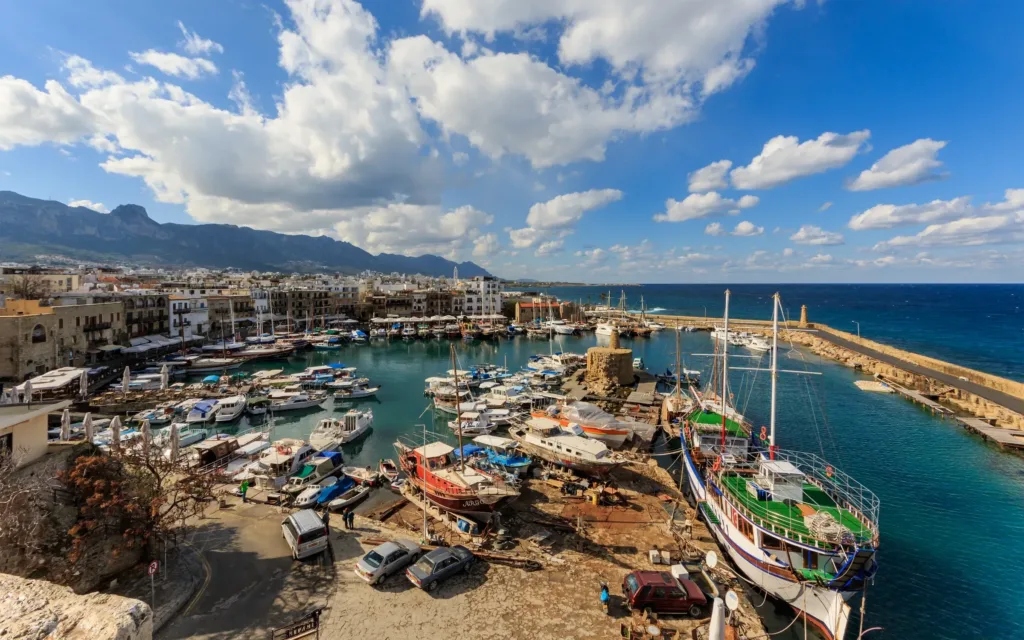
The old harbour lies right beneath the castle walls, and an old lighthouse stands on its western breakwater. Old houses line the waterfront, while the harbour itself is now used mainly by pleasure boats.
The castle at the entrance to the harbour is Kyrenia’s main landmark. According to the Department of Antiquities, its Byzantine core was rebuilt by the Lusignans in the 13th century and by the Venetians in the 16th century, while a 12th-century Byzantine chapel survives inside. The full history of the castle is in our separate guide to Kyrenia Castle.
The town’s maritime history is also told by the main find on display in the castle: a merchant ship of the 4th century BC that sank at the entrance to Kyrenia harbour. Its remains were conserved and reassembled in the castle before 1974.
The Kyrenia ship
The ship was found in 1965 by Andreas Cariolou, a member of Kyrenia Town Council, while diving for sponges: according to the Institute of Nautical Archaeology, he saw a mound of about 80 amphorae. In 1967 he led Michael and Susan Katzev to the wreck, and the University of Pennsylvania Museum excavated it in the summers of 1968 and 1969.
It was a Greek merchant ship carrying a cargo of amphorae, mainly from Rhodes. Most of the hull was raised, preserved and reassembled; according to the Department of Antiquities, the remains of the ship remain in Kyrenia Castle. For details about the cargo, the crew and the finds, see our guide to the castle.
The ship has become one of the symbols of Cyprus: it appears on the Cypriot 10, 20 and 50 cent euro coins, and the Central Bank of Cyprus dedicated its 2020 set of euro coins to it. According to the Deputy Ministry of Tourism, a replica of the ship can be seen at the Thalassa Municipal Museum of the Sea in Ayia Napa.
What to see nearby
Bellapais Abbey stands on the slopes of the Pentadaktylos range above Kyrenia: according to the Department of Antiquities, it is one of the most important examples of Gothic monastic architecture in the Eastern Mediterranean. The village of Bellapais is about 6 km away and is often combined with the town in a single itinerary.
Further west, on a peak about 725 m high, stands St Hilarion Castle. The Department of Antiquities says that it was built by the Byzantines at the end of the 11th century, together with the castles of Kantara and Buffavento, to defend the island against raids from the sea, and that under the Lusignans the royal family lived here in peacetime.
After the 14th century the mountain fortresses lost their military importance, and the Venetians dismantled them so that an enemy could not use them. Today both the range and the ruins of St Hilarion on its crags are clearly visible from Kyrenia.
How to get there from Nicosia
Kyrenia lies on the other side of the Pentadaktylos range from Nicosia. On the list of the Customs Department of the Republic of Cyprus, the Nicosia crossing points open to pedestrians only are at Ledra Street and Ledra Palace; drivers usually cross at Agios Dometios, and further west there is the Astromeritis–Zodhia crossing point.
The UK Foreign Office warns that hire cars from the south are often not insured in the north and that you will not be allowed through a crossing point without the correct insurance documents; insurance for the north can be bought at some crossing points, including Agios Dometios. Check in advance whether your hire company allows travel to the north.
Do not start your trip with a flight or a ferry directly to the north. According to the Cyprus Ministry of Foreign Affairs, the legal points of entry into the Republic are Larnaca and Paphos airports and the ports of Larnaca, Limassol, Latsi and Paphos, and entry via ports and airports in the north is illegal.
Accommodation, property and safety
The Cyprus Ministry of Foreign Affairs warns that staying in houses and hotels belonging to forcibly displaced Greek Cypriots may lead to lawsuits by the owners. This is especially relevant in Kyrenia: many houses and plots in and around the town belong to families who were forced to leave them in 1974.
Land in Kyrenia was at the heart of Loizidou v. Turkey: in 1996 the European Court of Human Rights held that denying the owner access to her land since 1974 violated her right to property. Do not buy or rent property in the north without consulting a lawyer.
According to the Cyprus Ministry of Foreign Affairs, the government of the Republic cannot guarantee the safety of visitors in the north or provide consular assistance there, and the UK Foreign Office warns that you may be detained for photographing military sites. For more on the status of the north and the risks of travelling there, see our guide to Northern Cyprus.
Continue planning
- Kyrenia Castle and Shipwreck Museum: History and Visit
- Bellapais Abbey, Kyrenia: History and Visiting Guide
- Northern Cyprus: Status, Crossing the Line and What to Check
Official sources
- Department of Antiquities of the Republic of Cyprus: Keryneia Castle and the Kyrenia ship
- Department of Antiquities of the Republic of Cyprus: Bellapais Abbey
- Department of Antiquities of the Republic of Cyprus: St Hilarion Castle
- Institute of Nautical Archaeology: Kyrenia shipwreck excavation
- Union of Cyprus Municipalities: occupied municipalities
- European Court of Human Rights: Loizidou v. Turkey (1996)
- Cyprus Ministry of Foreign Affairs: important information on travel to the Turkish-occupied area of Cyprus
- Customs Department of the Republic of Cyprus: crossing points
- UK Foreign Office (FCDO): Cyprus travel advice, safety and security
Kyrenia old harbour from the castle bastion · Photo: A.Savin · FAL · converted to WebP and resized.
