Bellapais Abbey, Kyrenia: History and Visiting Guide
About the place
Checked: 25 October 2026.
Bellapais Abbey: in brief
Bellapais Abbey stands in the village of the same name on the slopes of the Pentadaktylos mountain range, above Kyrenia, in the Kyrenia district, which has been under Turkish occupation since 1974. According to the Department of Antiquities of the Republic of Cyprus, it is one of the most important surviving examples of Gothic monastic architecture in the entire Eastern Mediterranean.
The monastery was founded during the Lusignan period at the turn of the 12th and 13th centuries, whilst the main buildings – the church, cloister and refectory – date from the 13th and 14th centuries. The Deputy Ministry of Tourism lists the abbey amongst the most famous Gothic monuments from the Frankish period in Cyprus, alongside the cathedrals of Saint Sophia in Nicosia and Saint Nicholas in Famagusta.
Below, you’ll find details of who founded the abbey and when, what to see in the church, the cloister and the refectory, how the writer Lawrence Durrell is connected to the village, and what to bear in mind when visiting.
Foundation and name
According to the Department of Antiquities, the earliest written sources refer to the abbey as a house of Augustinian canons founded by the King of Jerusalem, evidently Aimery de Lusignan, who reigned from 1198 to 1205. The Norbertines themselves state that construction began in 1198, and that from 1206 the monastery passed to the Premonstratensian canons.
The monastery was originally called Episcopia or Piscopia. The Department of Antiquities suggests that it was built on the site of the home of the Greek bishop of Kyrenia, who took refuge here during the Arab raids. Later, the name changed to Lapais, and it was from a corrupted form of this that the current name emerged in the 16th century.
A popular explanation traces the name Bellapais back to the French ‘Abbaye de la Paix’ – ‘Abbey of Peace’. The Norbertines themselves acknowledge that the exact origin of the name has been lost, so this version should be regarded as a tradition rather than an established fact.
The rock, the walls and the setting
The abbey was built on a natural rock escarpment: according to the Department of Antiquities, its northern edge drops away more than 100 metres, which provided the monastery with reliable protection. An artificial ditch was dug on the south and west sides, whilst the monastery itself was surrounded by a defensive wall.
Thanks to its location, the abbey offers views of the north coast and Kyrenia. The village of Bellapais is about 6 km from Kyrenia, so it is often included in the same itinerary as the town and the castle.
Most of the buildings that have survived to this day were erected during the reigns of Kings Hugh III and Hugh IV, who ruled in the 13th and 14th centuries. According to historical accounts, under Hugh IV, a cloister and a refectory, as well as the royal apartments, were built at the abbey.
The church and the cloister
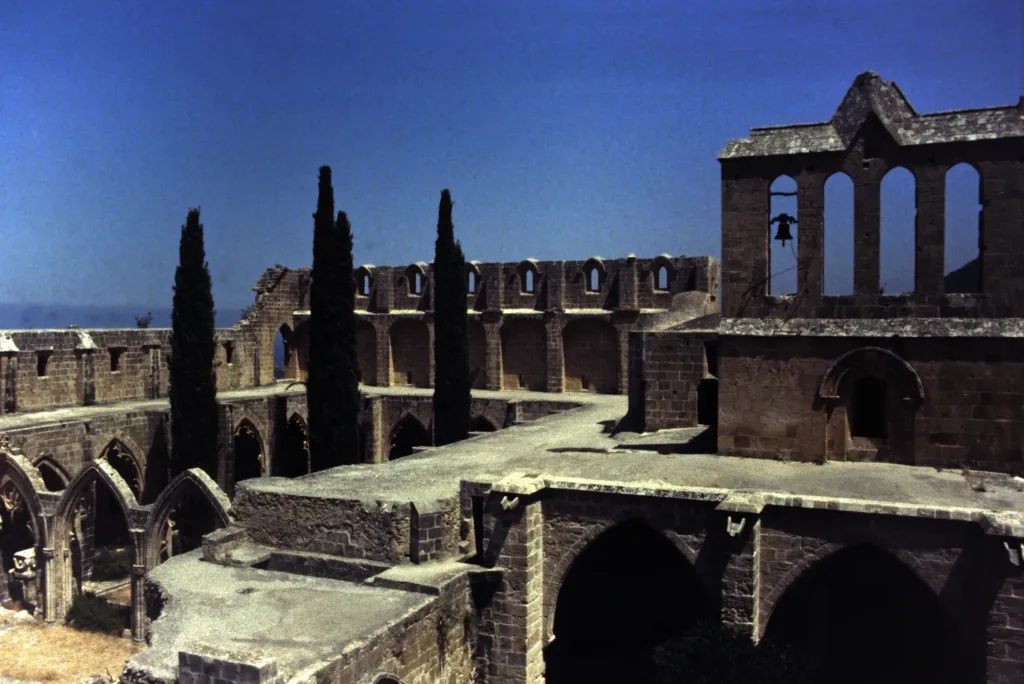
The best-preserved part is the 13th-century church. According to the Department of Antiquities, it has a square-ended chancel, a crossing with transepts and a nave of two bays with aisles; the capitals are in the Frankish style. Traces of a 14th-century painting of the Apostle James survive on the south wall of the chancel.
Following the Ottoman conquest in 1570, according to the Department of Antiquities, the Ottomans seized the abbey and its property, but allowed the villagers to continue using the church. The Latin canons were expelled, and the church, with minor alterations – such as a new iconostasis – served the Orthodox inhabitants of the village.
The 14th-century cloister has survived, with the exception of the west wing. Its corbels are decorated with carvings featuring plant motifs and human figures. In the north-west corner stands a marble lavabo with a carved Roman sarcophagus of the 2nd century AD built into it: the canons washed their hands there before meals.
The refectory and the underground rooms
Behind the lavabo is the main entrance to the refectory. According to the Department of Antiquities, the coats of arms of the Lusignans, Jerusalem and Cyprus are carved into its marble lintel. The refectory itself, as the department notes, is a majestic vaulted hall with six bays.
Remains of benches can still be seen along the walls of the refectory, and the bench by the east wall is set higher than the others: the abbot’s table probably stood there. A staircase in the north wall leads up to the pulpit, from which the Scriptures were read during meals.
Beneath the refectory lies a vaulted crypt comprising two spacious rooms, where olive oil and other provisions were stored. East of the cloister lies the undercroft of the dormitory, where a stonemason’s mark is visible on almost every stone, and the square chapter house.
Bellapais after 1974 and Lawrence Durrell
After the Turkish invasion of 1974 the Greek Cypriots were forced to leave the village, and, according to the Norbertines, the occupying authorities closed the church in 1976. Since then, the abbey has been open to visitors as a historic site, and concerts are held within its walls.
The village was made famous by the British writer Lawrence Durrell, who lived in Cyprus from 1953 to 1956 and bought a house in Bellapais. His memoir Bitter Lemons was published in 1957 and won the Duff Cooper Prize that same year.
In the book Durrell describes the ‘Tree of Idleness’, under which the villagers used to drink coffee. Today, two establishments claim to be this very spot, whilst the book itself remains one of the best-known accounts of life in Cyprus in the 1950s.
How to visit
Bellapais is situated in the occupied part of the island, not far from Kyrenia. Travellers usually reach it from the south through the crossing points in the Nicosia area; the rules for crossing, car insurance and legal risks are described in our articles on Northern Cyprus and the Green Line.
Check opening hours and admission prices on site: the Republic’s official sources do not publish this information. Wear comfortable shoes — there’s a lot of walking on stone floors and up and down stairs in the abbey, and stay well clear of the edge at the cliff on the north side.
The abbey can easily be combined with a visit to Kyrenia and Kyrenia Castle, which have their own guides on our site. In spring and early summer, concerts are held at the abbey; the programme and dates are published by the organisers.
Continue planning
- Kyrenia: the harbour, the old town and planning a visit
- Kyrenia Castle and Shipwreck Museum: History and Visit
- Northern Cyprus: Status, Crossing the Line and What to Check
Official sources
- Department of Antiquities of the Republic of Cyprus: Bellapais Abbey
- Deputy Ministry of Tourism: Cyprus, 10,000 years of history and civilisation
- The Norbertines (Premonstratensian canons), London: Norbertines on the Med
The cloister and church of Bellapais Abbey · Photo: Rüdiger Stehn from Kiel, Deutschland · CC BY-SA 2.0 · converted to WebP and resized.
