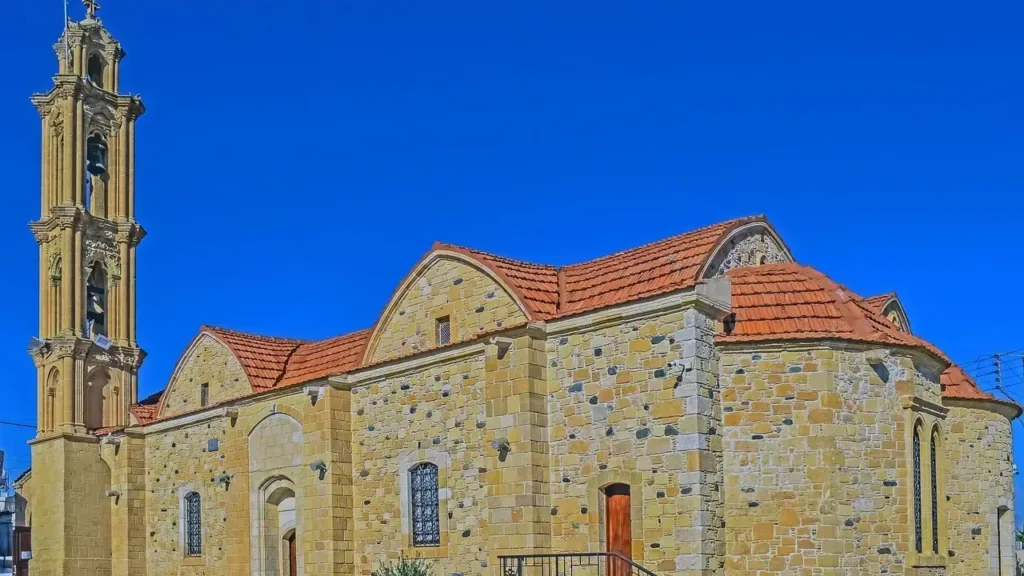
Meniko, Cyprus: village guide near Nicosia and the Akaki river
About the place
Checked: 25 October 2026.
Meniko at a glance: a village on the Akaki river south-west of Nicosia
Meniko (Greek: Μένοικο) is a village in the Nicosia district. According to the community council, it is situated approximately 27 km south-west of Nicosia, near the southern bank of the Akaki river, at an average altitude of around 250 m above sea level. At the 2021 census Meniko had 1,037 residents. The village is best known for the Church of Saints Cyprian and Justina, which attracts pilgrims.
In Greek the name is spelt in two ways, Μένοικο and Μένικο, and in Latin script the village appears as Meniko or Menoiko. All of these refer to the same place. Meniko lies on the road leading from the western suburbs of Nicosia, through Agioi Trimithias and Palaiometocho and on westwards to Agioi Iliofotoi and Kato Moni.
Meniko is a residential village, not a holiday resort, and is easy to visit on a day trip from Nicosia. Our site has a separate guide to the Church of Saints Cyprian and Justina. This article focuses on the village itself: its history, the surrounding area and how to plan your visit.
History of Meniko and the origin of its name
According to the community council, the site on which the village stands has been inhabited since ancient times. Excavations here uncovered a small rural sanctuary of the 6th century BC containing many clay figurines. The council links the sanctuary to the cult of the god Baal-Ammon; in academic literature, this deity is usually referred to as Baal-Hammon.
The name Meniko, in its present form, is known from medieval sources. One theory links it to a man named Domenico, a resident or landowner in this area during the Frankish period. The community council, however, believes the name is older than the Frankish era and allows that it may go back to the ancient Greek personal name Menoikeas (Μενοικέας).
The village’s parish church is dedicated to Saints Cyprian and Justina, and its patronal feast day is celebrated on 2 October. Church tradition offers different accounts of how the relics came to Meniko and when the present church was built, and popular sources give conflicting dates. We therefore give no exact dates and suggest asking about the church’s history at the parish itself.
What to see in Meniko
The main attraction is the Church of Saints Cyprian and Justina. According to church tradition, it holds portions of the relics of these saints, and the church is revered as a place of prayer for protection against witchcraft and evil forces. A separate guide on our site covers the church’s history, its relics and visiting etiquette in detail.
A second distinctive feature of Meniko is its setting by the Akaki river. The village stands near the southern bank, and as you enter, you can clearly see how the residential areas give way to a rural landscape of fields and orchards. For a short walk around the outskirts, choose the morning or evening, when it is cooler.
The finds from the ancient sanctuary – clay figurines dating from the 6th century BC – belong to the earliest period of Meniko’s history. If you are interested in archaeology, check in advance with the Department of Antiquities to find out where the finds from Meniko are currently stored or on display, and whether it is possible to visit the excavation site.
Festivals and church traditions in Meniko
The village’s main festival is the feast day of Saints Cyprian and Justina on 2 October. In Cyprus a church’s feast day is usually accompanied by a panigyri, a village fair with stalls, food and music. The programme for the festival, the times of the church services and the format of the fair vary from year to year, so check with the church or the community council.
The Church of Saints Cyprian and Justina makes Meniko a place of pilgrimage. According to church tradition, people pray to these saints for protection against witchcraft and evil spirits, and many come here specifically to pray. We describe this tradition as part of local religious life, not as a promise of any particular outcome.
According to local tradition, the church has a spring whose water pilgrims regard as holy and take away with them. If you wish to collect some water, ask the church attendants where and how this is customarily done, and do not use the spring to wash your hands or for any other everyday purpose.
Around Meniko: towards the Troodos foothills and Asinou
The Visit Cyprus cycling route ‘Lefkosia 3 – Lefkosia (Nicosia) – Aderfoi Forest – Asinou’ passes through Meniko. It starts on the outskirts of Lakatamia, runs through Agioi Trimithias and Palaiometocho to Meniko, and then heads towards Kato Moni and further into the mountains. The total length of the route is 85.9 km, and Meniko comes at roughly kilometre 21.
Visit Cyprus rates the route as difficult: the average gradient is about 2% and never exceeds 5%, and the distance is meant for fit, experienced cyclists. For drivers, the same road is a useful direction to follow: from Meniko, you can continue via Kato Moni to the villages at the foot of the Troodos Mountains.
The route ends at the church of Panagia tis Asinou, part of the UNESCO World Heritage property ‘Painted Churches in the Troodos Region’. If you wish to visit Meniko and Asinou in a single day, bear in mind that the road into the mountains is winding, and check in advance when both churches are open.
Getting to Meniko and planning your visit
The easiest way to get there is by car. From Nicosia, the route to Meniko takes you through the western suburbs and the villages of Agioi Trimithias and Palaiometocho, as on the Visit Cyprus cycling route. Before setting off, check the current route in your navigation app, as the road network around Nicosia is changing.
Buses to rural communities in the Nicosia district run less often than buses within the city. If you are planning to travel by public transport, check the route and timetable with the Nicosia district bus operator shortly before your journey and be sure to note the time of the return bus.
A couple of hours is usually enough to visit the church and take a short walk around the village. The trip can easily continue towards Kato Moni and Asinou or be combined with other churches in the area. If you visit on 2 October, expect large numbers of pilgrims and possible difficulty parking.
What to check before visiting Meniko
The opening hours of the church depend on the season, services and feast days. Check them with the parish or the Meniko community council before you go. On Sundays and feast days the church may be busy with services, which makes it an awkward time to look around.
The usual rules for an Orthodox church apply here: cover your shoulders and knees, keep your voice down and switch your phone to silent. During the service, please do not walk around the church or take photographs without permission.
Meniko is a residential village, so when parking take care not to block driveways or the road for local residents. In summer, it can get very hot in the lowlands of Cyprus: plan your walks for the morning or evening and make sure you take water and a hat with you.
Continue planning
- Nicosia: the capital in the centre of the island
- Church of Saints Cyprian and Justina in Meniko
- Cyprus itinerary for 3, 7 and 10 days
Official sources
- 2021 Population Census — Cyprus Statistical Service (CYSTAT)
- Community Council of Meniko profile — UNESCO Chair on Digital Cultural Heritage, Cyprus University of Technology
- Lefkosia 3 cycling route (Nicosia – Asinou) — Visit Cyprus
Church of Saints Cyprian and Justina in Meniko · Photo: Dimitris Vetsikas (dimitrisvetsikas1969) · Pixabay Content License · converted to WebP and resized.
St. Cyprian and Justine pray for us