Vavatsinia village, Cyprus: the mulberry village by Machairas forest
About the place
Checked: 29 October 2026.
Vavatsinia at a glance: a Larnaca mountain village by Machairas forest
Vavatsinia (Greek: Βαβατσινιά) is a mountain village in the Larnaca district, on the southern edge of Machairas forest (Μαχαιράς). According to the village website, it stands at about 850 m and is one of the two highest mountain villages in the Larnaca district. According to Visit Cyprus, the official portal of the Deputy Ministry of Tourism, it is about 10 km by road from Pano Lefkara.
According to the 2021 census, the village has 75 residents. Do not confuse it with neighbouring Agioi Vavatsinias (Άγιοι Βαβατσινιάς): the Statistical Service of Cyprus (CYSTAT) counts them as two separate communities, and along the Visit Cyprus cycling route they are about 7 km apart.
Vavatsinia is known for the tree that gave it its name, the old pine by the coffee shop, its stone architecture, the village still for zivania and its trails into Machairas forest. The Larnaka Tourism Board includes it in the Orini Larnaca group of mountain villages, which holds the European EDEN award. Lefkara has its own guide on our site.
What is vavatsinia: the tree that gave the village its name
The village’s name is the Cypriot word for the mulberry tree. The village website explicitly calls ‘vavatsinia’ the local mulberry, and the Cyprus Food Virtual Museum gives the Cypriot word ‘vavatsinos’ for mulberries and blackberries. So the ‘vavatsinia fruit’ is the mulberry.
According to the village website, the tree itself grows in the lower part of Vavatsinia, by the stream that the road to the neighbouring villages crosses. According to tradition, the mulberry was already growing here before the settlement existed, and it still bears large dark berries. There was a spring at its roots, and travellers from Agioi Vavatsinias, Odou and Ora on their way to Lefkara would stop here.
The Food Museum notes that in Cyprus mulberries were long planted on irrigated land and in courtyards all over the island, and that mountain trees gave the finest silk. Vavatsinia’s second famous tree is an old pine, which the village website calls its symbol. It grows in the courtyard of the St George coffee shop, housed in the building of the first village school, and according to older residents it was planted by the pupils.
History and character of the village
According to a tradition cited by the village website, Vavatsinia arose at the time of the Arab raids. Its first inhabitants were shepherds from coastal villages who took their flocks up into the mountains to escape attacks from the sea. We have found no documented founding dates, so this is local tradition rather than established fact.
The village website describes narrow cobbled lanes, two-storey stone houses, paved courtyards with flowers and clay jars, and wooden gates and doors. The village sits on steep slopes, so its streets are constantly climbing and descending. In the centre there is a square with a small park.
The village zivania still stands here too. According to the village website, it was donated by one of the residents, the building was renovated in 2007, and many families still distil zivania in it. In this way the village keeps up a tradition shared by the mountain villages of Cyprus.
Churches and holy places of Vavatsinia
According to the village website, Vavatsinia has two churches and three chapels. The main church is dedicated to St George the Victorious. It is a basilica in the centre of the village, built in 1912 with money from a Vavatsinia native who had emigrated to Egypt. According to tradition, a large terebinth tree, ‘trimithia’ in Cypriot, once grew on this spot, and villagers lit candles under it in honour of St George.
St George’s church celebrates its feast days on 23 April and 3 November. Next to the church is the agiasma of St George, a spring whose water the village regards as holy.
The village’s first church was that of the Virgin Eleousa (Panagia Eleousa, the Merciful). According to the village website, it was rebuilt in 1850. Its rare women’s gallery on the upper level at the back of the church is protected by the Department of Antiquities. The church’s feast day is 15 August. Among the chapels, the village website names those of the Saviour and of Panagia Koumniou.
Machairas forest and the trails around the village
Machairas forest begins north of Vavatsinia. Visit Cyprus says that part of it belongs to Machairas National Forest Park, which is also part of the Natura 2000 network. From the village a road runs through the forest to the Kionia picnic site and Machairas Monastery; according to Visit Cyprus, the Kionia – Profitis Ilias trail can also be reached from this road.
The trail to Athashia cave starts on a dirt track that branches off the Vavatsinia – Kionia forest road about 3 km from the village. According to the Larnaka Tourism Board, it is 2.5 km one way, and you return the same way. The trail leads to an old cave that is thought to have been dug in search of ore; the last stretch is a steep descent.
The circular Karvounarka trail starts at the entrance to the village from the Lefkara side. The village website describes views from it over the village itself and the Nicosia plain, and, from the start of the dirt track, over Episkopi Bay and Limassol port. Visit Cyprus cycling routes through the Larnaca mountain villages also pass through Vavatsinia.
How to get to Vavatsinia and plan your visit
The easiest way to get there is by car. From Larnaca and Limassol, leave the motorway at the Skarinou junction and drive up through Pano Lefkara: Visit Cyprus describes this as the Skarinou – Vavatsinia road. Beyond Lefkara the road is mountainous and winding.
From Nicosia you can drive through Machairas forest past the monastery, but these are narrow forest roads, best checked in advance in winter and after rain. Bus services to the Larnaca mountain villages are limited, so if you have no car, check with the operator in advance whether there is a service and when the return one runs.
A walk around the village takes an hour or two, or half a day with the trail. The trip combines well with Pano Lefkara and Agioi Vavatsinias or with Machairas Monastery. The village website mentions tavernas in Vavatsinia serving Cypriot food and homemade sweets.
What to check before visiting Vavatsinia
According to the village website, the churches open mainly on Sundays and on their feast days. If you want to see a church on another day, phone the community council in advance: the number is on the village website. The usual church etiquette applies: covered shoulders and knees, quiet voices.
In summer the fire risk in the forest is high. Follow the Department of Forests’ rules: do not light fires outside designated areas, do not leave litter and keep to marked trails. The Athashia cave trail is linear and has a steep descent, so take water and set off early enough to be back before dark.
According to Visit Cyprus, photography and filming are not allowed at Machairas Monastery, and visiting hours may change. The mulberry season is short, so if you want to catch the berries, ask locals when they ripen this year.
Continue planning
- Lefkara: lace, silver and a stroll through the village
- Larnaca: what to see, where to stay and how to plan your trip
- Hiking routes and nature trails in Cyprus
Official sources
- Statistical Service of Cyprus: Census of Population 2021, population by community
- Vavatsinia village website
- Cyprus Food Virtual Museum: berries, vavatsino
- Visit Cyprus: Kionia – Profitis Ilias trail, Machairas Forest
- Larnaka Tourism Board: Vavatsinia – Cave of Athashia trail
- Visit Cyprus: Mazotos – Vavatsinia – Kofinou cycling route
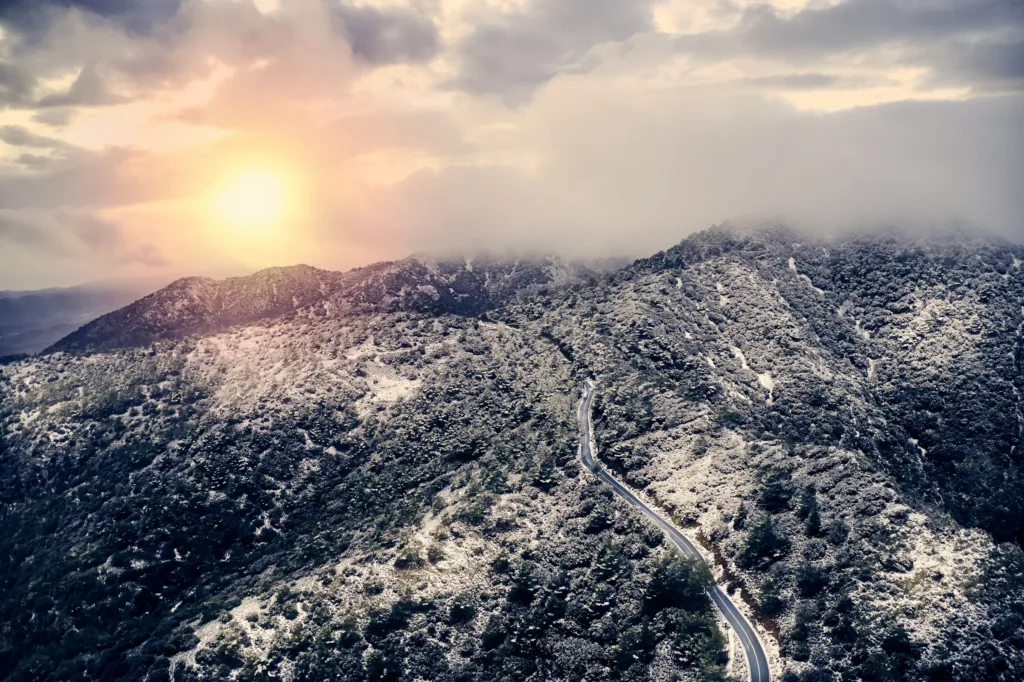
A mountain road near Vavatsinia in winter · Photo: Deensel · CC BY 2.0 · converted to WebP and resized.
